Pokémon cards now mirror real-world financial assets. PokéIndex gives investors, collectors and enthusiasts transparent, reliable pricing — and the tools to understand a market that has matured into a true asset class.
| Loading… |
| Loading… |
| Loading… |
| Loading… |
| Loading… |
| Loading… |
| Loading… |
| Loading… |
A card doesn't have one price — it has many. It sells for one figure in America, lists for another in Europe, and trades graded in a market of its own. Look in any single place and you're seeing a fraction of the truth.
PokéIndex collates pricing points from markets around the globe and embeds them into a single card view — raw and graded, sold prices and live asks, side by side and blended into one clear figure. When you look up a card here, you're not seeing one website's opinion. You're seeing the world market's verdict — so you can know, with confidence, what a card is actually worth.
Global prices, in one card. That's the whole idea.
PokéIndex was built on a simple conviction: Pokémon cards have become a financial asset class — and nobody was treating them like one.
The stock market has Bloomberg. Crypto has its terminals and tickers. But the collector standing in a card shop, weighing up a £2,000 Charizard, has been left to piece together screenshots, forum hearsay and gut feel. We built PokéIndex to close that gap: institutional-grade market analytics, for cards.
PokéIndex was created by a trader who spent fifteen years in the financial markets, pricing risk and reading price action for a living — and who has been collecting Pokémon cards since the age of nine.
For years those were two separate worlds. One was spreads, volatility and indices; the other was binders, booster packs and the smell of a freshly opened pack. Then, somewhere along the way, the two worlds merged. Graded slabs began behaving like securities. Populations, condition premiums and auction results started moving the way order books move. Vintage cards developed the supply-and-demand character of scarce assets. The hobby hadn't just grown up — it had financialised.
Watching that happen from a trading desk, one thing became obvious: this market had real capital flowing through it, but none of the infrastructure serious capital deserves. No price index. No consolidated tape. No honest way to ask the questions any investor would ask of any other asset: What's it really worth today? How volatile is it? What's it done over twelve months? Is the whole market rising, or just the card I happen to be staring at?
So we built the thing we wished existed.
Every card. Every set. From the beginning. Every day, PokéIndex tracks prices across the market globally — covering both English and Japanese cards, raw and graded, from 1999's Base Set to this month's newest release.
On top of that data we've built the full toolkit of a professional market terminal:
Behind every one of those charts sits the same engine: tens of thousands of cards priced daily across raw and graded markets, with years of sale history behind them. Few asset classes this young have data this deep — and it compounds every single day.
Anyone who has traded on bad data knows it's worse than no data. So PokéIndex runs on a rule that costs us nothing but discipline: we would rather show you no price than the wrong price.
Thin, unreliable listings get filtered. Suspect data gets flagged, not hidden. Where a value is estimated rather than observed, we mark it as an estimate — built on established market practice, never presented as a live sale. And when two similar cards can't be told apart with certainty, we hold back rather than guess. Every number on this site is one we're prepared to stand behind.
Whether you're a collector who wants to know what your childhood binder is worth, an investor sizing up an alternative asset, or a player wondering whether to grade your pulls — you deserve the same quality of information a trader gets before risking a dollar.
That's the standard this site is built to. Not a price-checker. A market terminal for what your nine-year-old self already knew was treasure.
PokéIndex tracks Pokémon card prices from the world's major markets — eBay sold listings, TCGPlayer and Cardmarket — plus graded-card values for every major grading company, and brings them together in one place, in your currency. English and Japanese cards each have their own complete, separate price data.
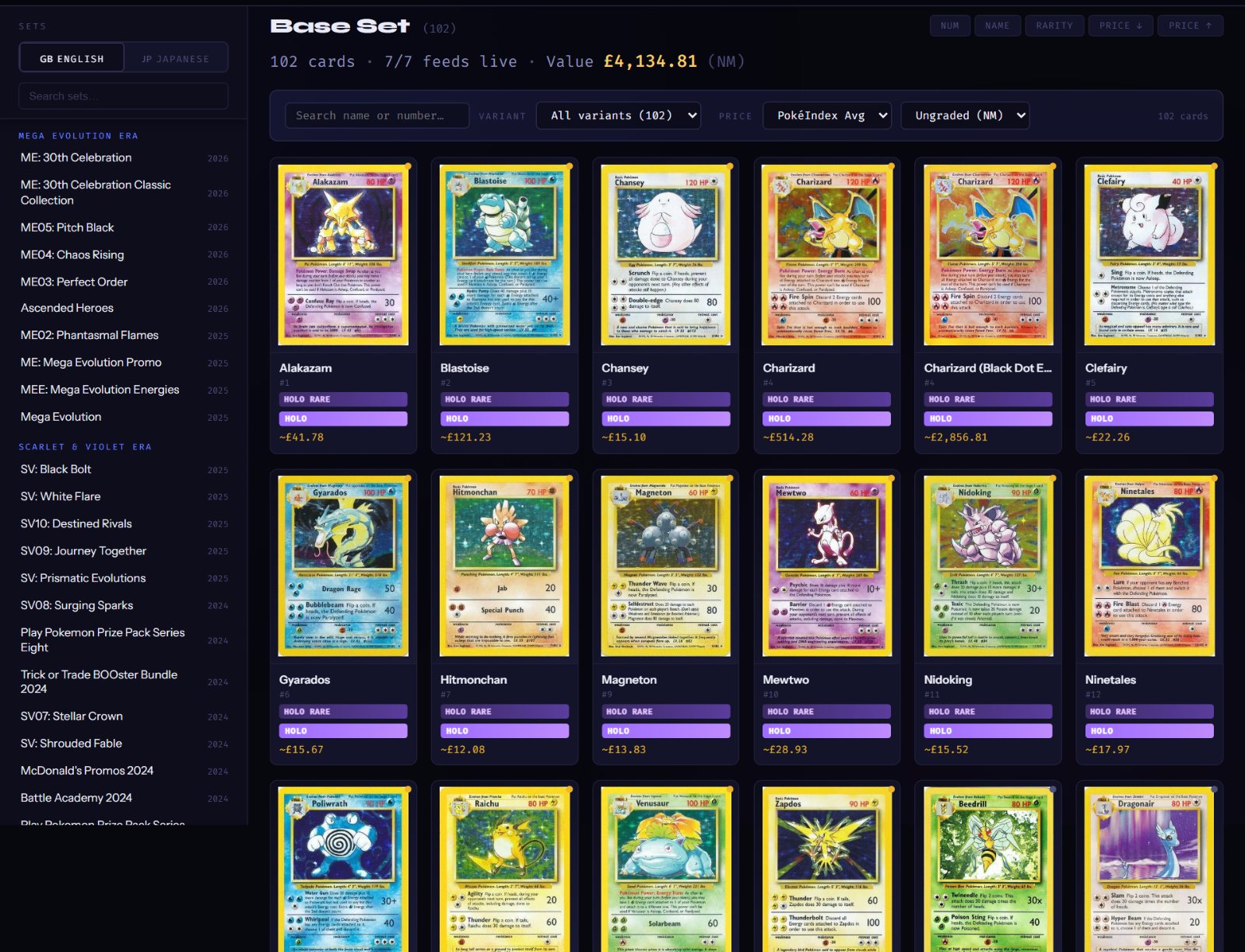
The left sidebar lists every set, grouped by era, newest first. Use the 🇬🇧 English / 🇯🇵 Japanese toggle at the top to switch languages, and the Search sets… box to jump straight to a set by name.
For the classic WOTC-era sets (Base Set, Jungle, Fossil, the Gyms and Neos), clicking the set name in the sidebar opens a small sub-menu so you can browse the ① 1st Edition and ∞ Unlimited printings separately — and for Base Set, Shadowless too. They're different cards with different prices, so each gets its own view.
Open a set and every card in it appears as a tile. Here's the real Base Set page with each control lettered — the list underneath explains what each one does.
Click any tile and you get the full picture for that exact card. Below is the real card page for Charizard · Base Set #4 (Holofoil), top to bottom, frozen on 23 Sept 2026 — the live page always shows today's numbers. Each part is explained underneath, top to bottom. When you've read it, open a real page with the button at the end — Charizard 1st Edition (Base Set Shadowless), which PokéIndex opens in full to every visitor so you can see every zone without an account.
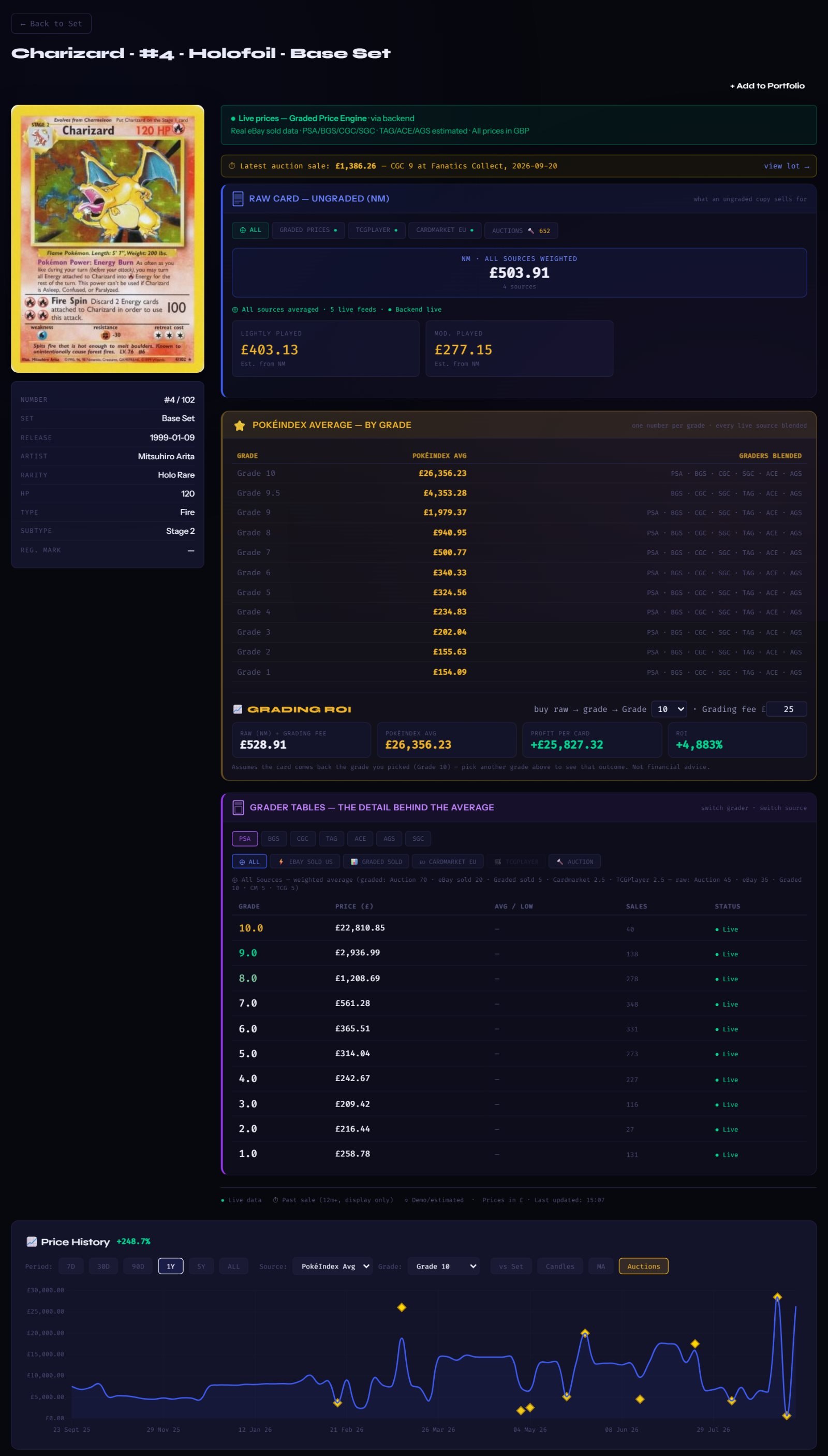
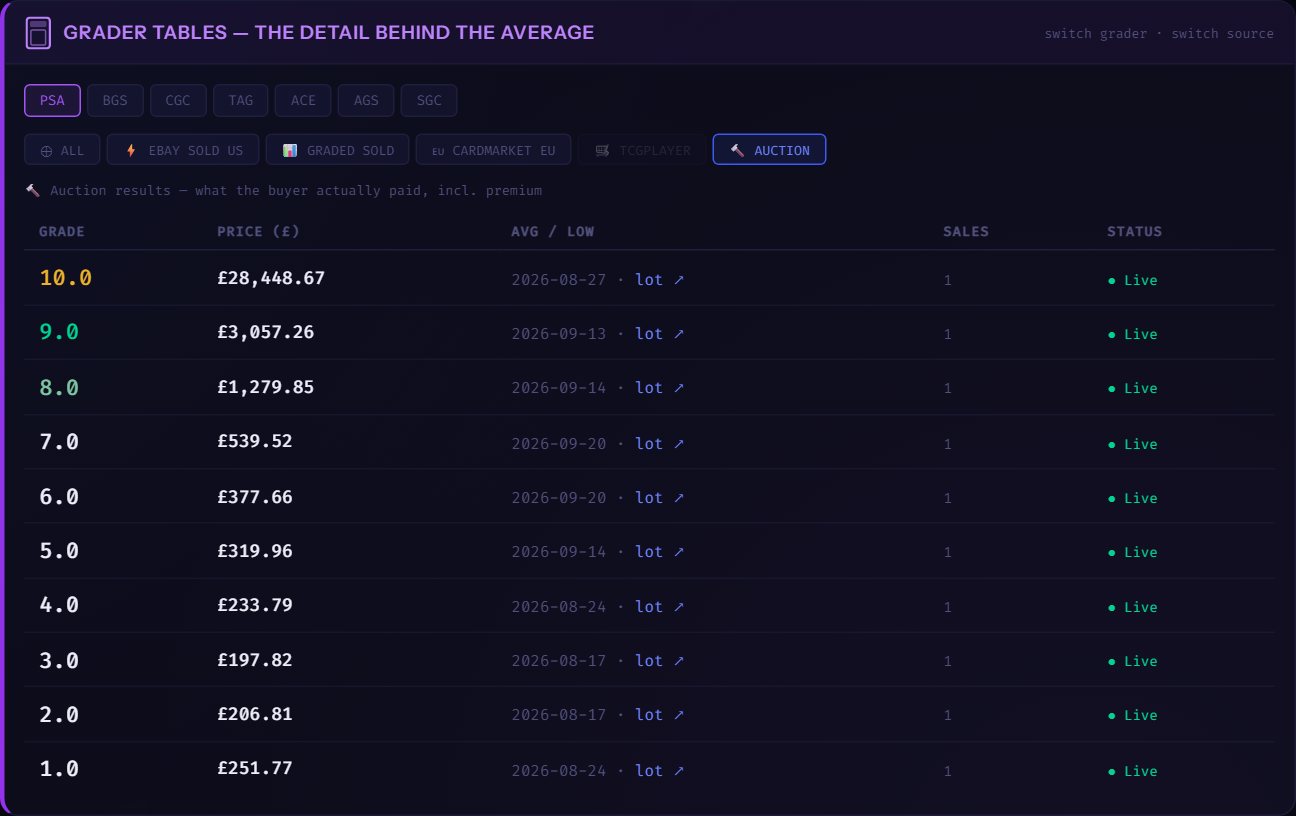
Same layout, today's prices — this card page is free for everyone, in full. Use ← Back to return here.
PokéIndex Avg is an average. It blends every price source and every grading company's data into one representative figure per grade — the best single answer to "what is this card worth?"
The graded table is not an average. For each grader and grade it shows the last correct sold price — the most recent real sale that passed our checks, with its date. It answers "what did this exact slab last sell for?"
An auction price is a real sale. Choose the Auction source, or a gold diamond on the chart, and you are looking at what one buyer actually paid on one day, premium included, with a link to the lot.
Use the Avg to understand a card's overall value. Use the grader tables and auction sales to see real, dated prices for the exact slab you own or want.
How our estimates work — where a grade has no recent sale, we estimate it from the card's real recorded sales using established market practices: the premiums the grading market itself applies between companies and grades, and interpolation between known prices. We don't publish the exact calculations, but every estimate is anchored to real sales and always marked with ○ — you will never mistake an estimate for a recorded sale.
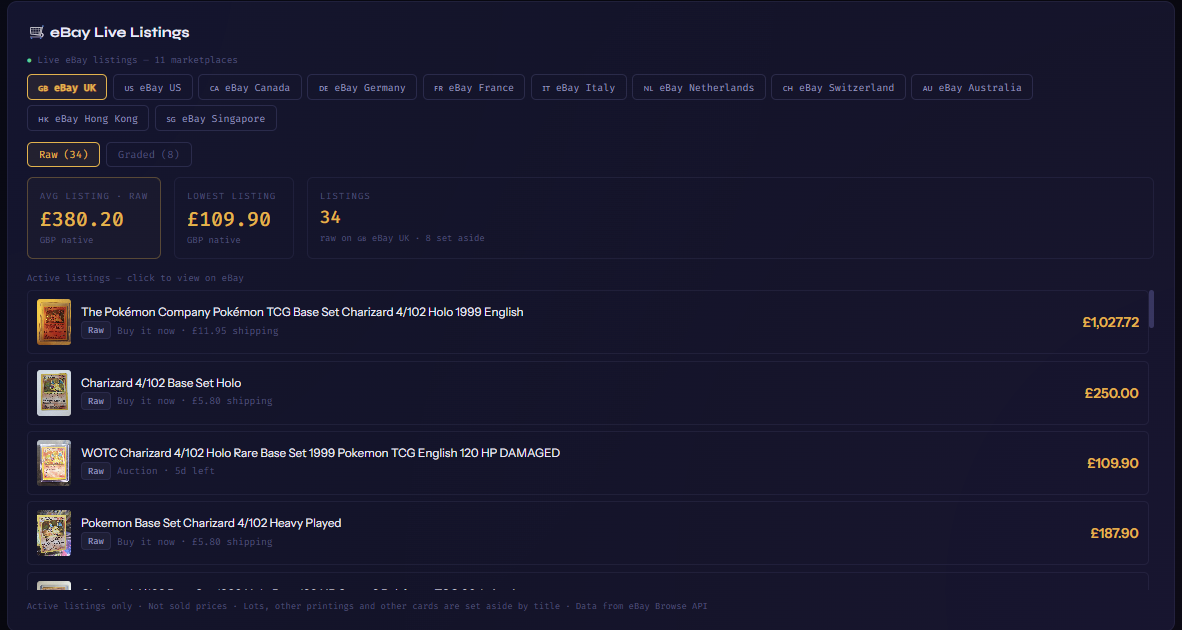
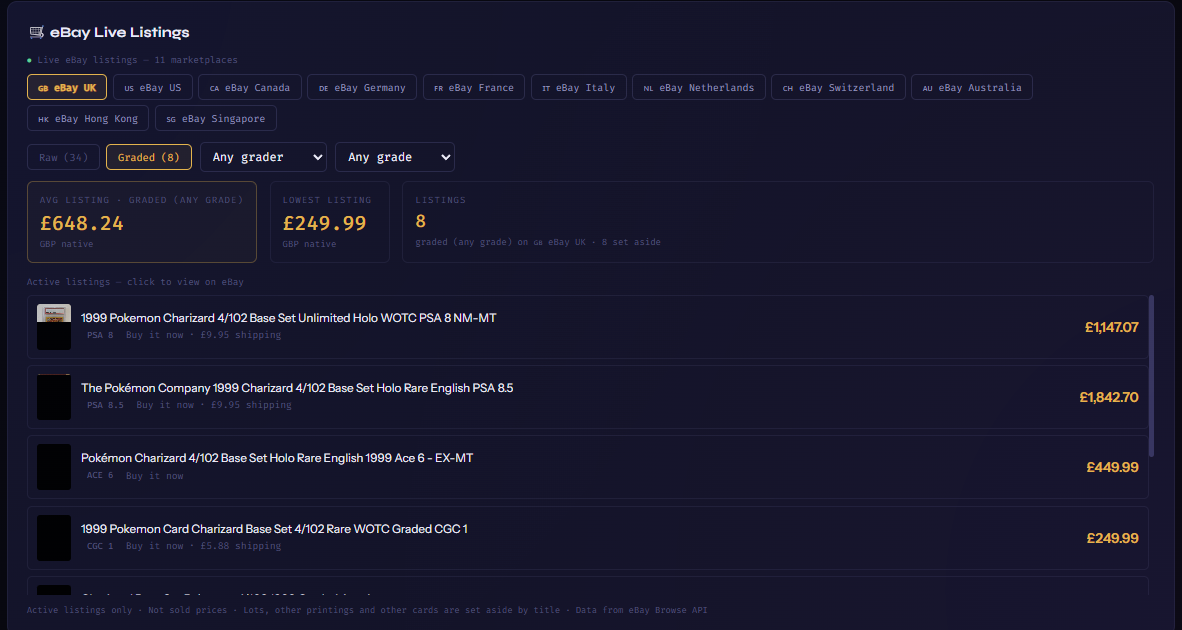
At the bottom of every card page: what is for sale right now on eBay for that exact card. Asking prices, not sold prices. Every listing's title is read by the same engine that matches auction lots to cards, so lots, bundles, reprints, other printings and other-language copies are set aside before you see anything. Free for everyone.
Market Stats is PokéIndex's trading floor: seventeen charts and boards covering the entire tracked market. Three filters repeat across almost all of them, so once you know these you can drive everything:
🇬🇧/🇯🇵 — English, Japanese or all sets NM / PSA 10 — raw or graded prices 1M · 3M · 1Y — the time window
Plans: Market Index, Price Index, Market Pulse and Set Value are free for everyone (Near Mint and PSA 10), and so is the price ticker. The Price Movers and Most Valuable boards show the top 3 free, the top 5 on Collector and everything on Investor. On Auction Houses the monthly volume chart and the collection health line are free; the notable-sales strip and the 7-day and 30-day top-sales boards are Collector (their top 5), and the all-time board and browsing sales by house are Investor. The remaining charts and boards are Investor features.
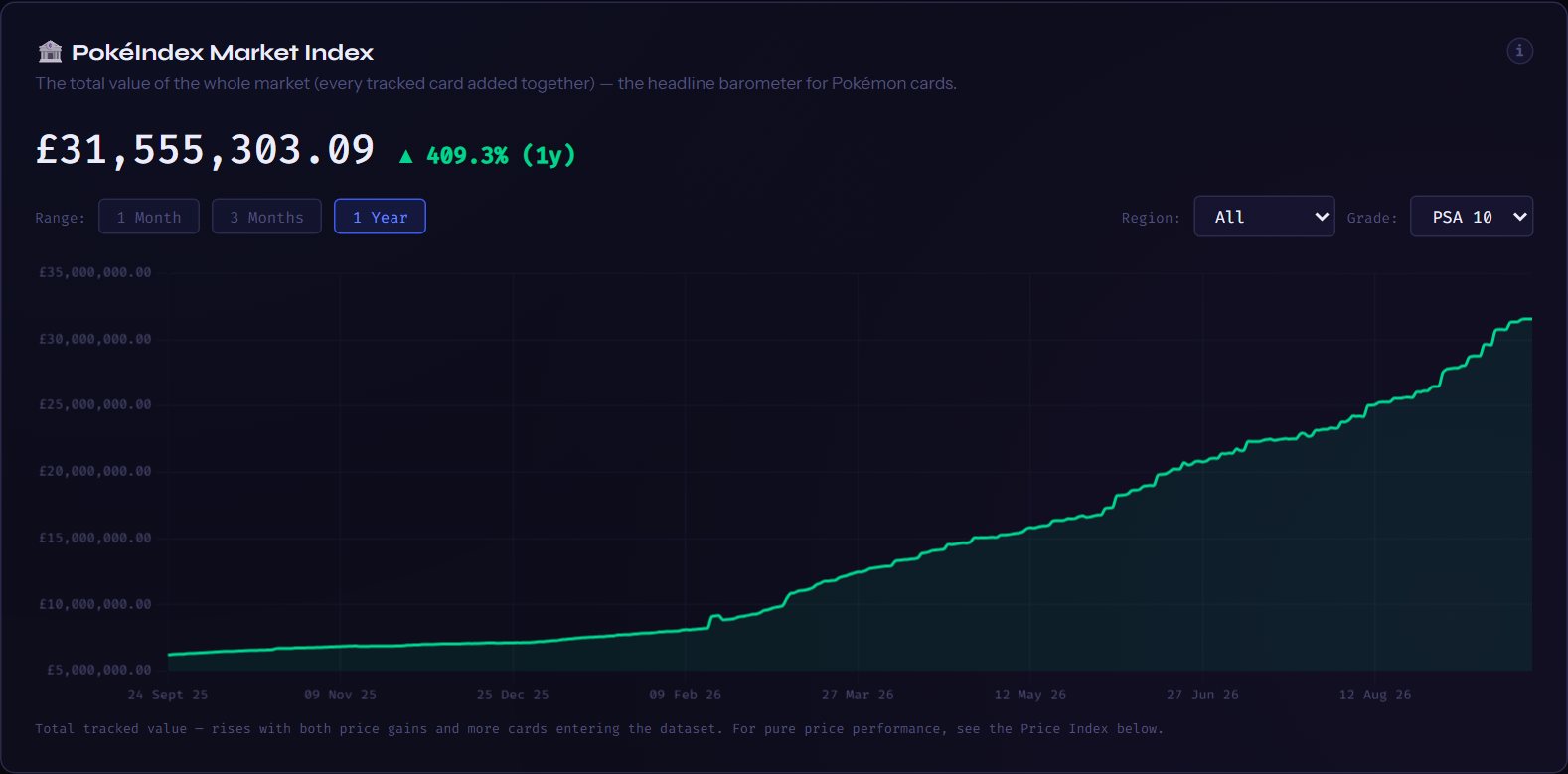
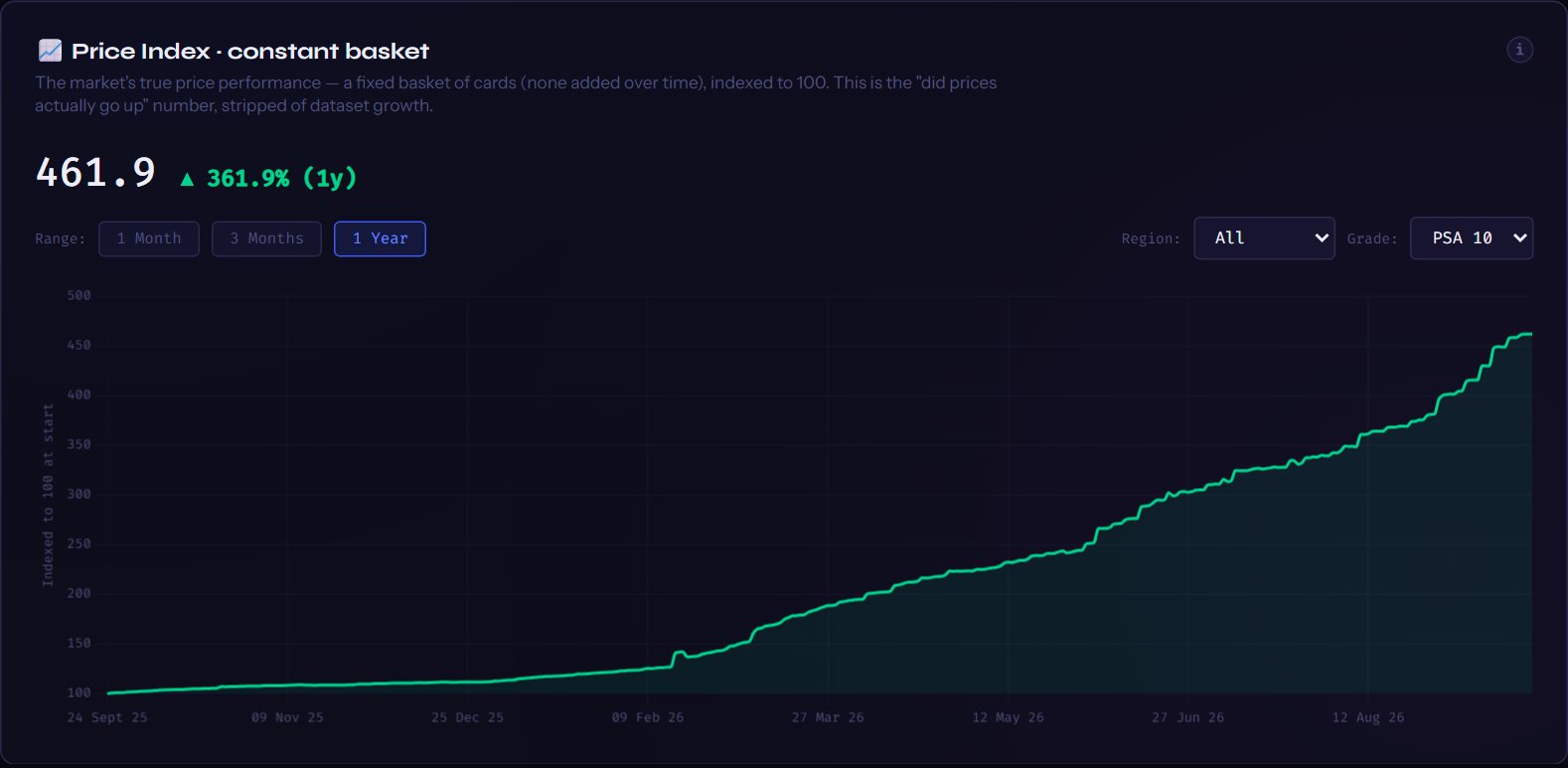
A chip bar at the top of the page jumps to any chart, the "Market data through…" stamp shows data freshness, and every chart carries an ⓘ button explaining what it shows and why it matters. Here's the full directory, each with a real picture of that chart as it looked on 23 Sept 2026 — click any title or picture to open the live chart:
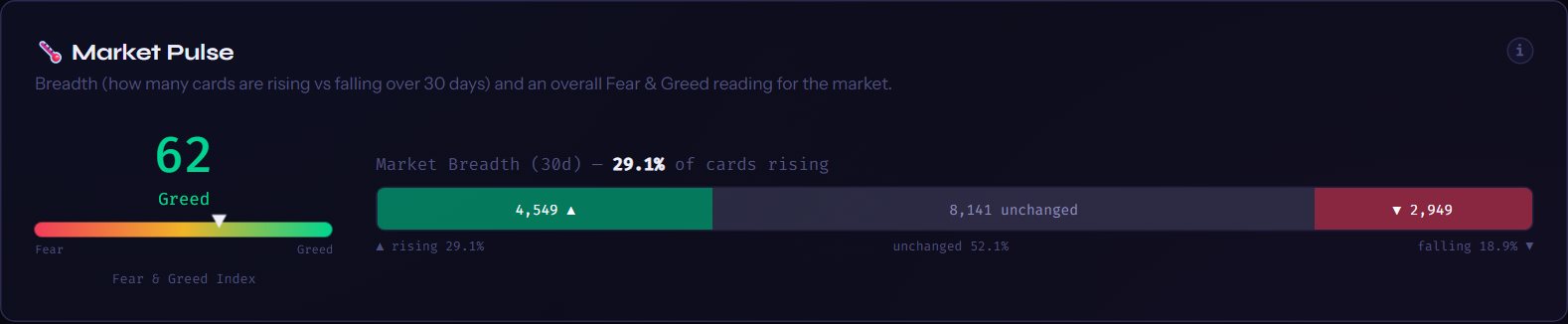
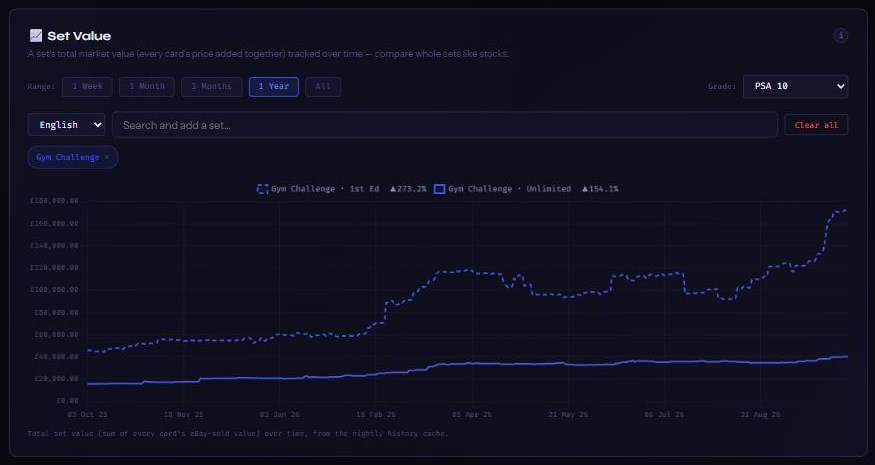
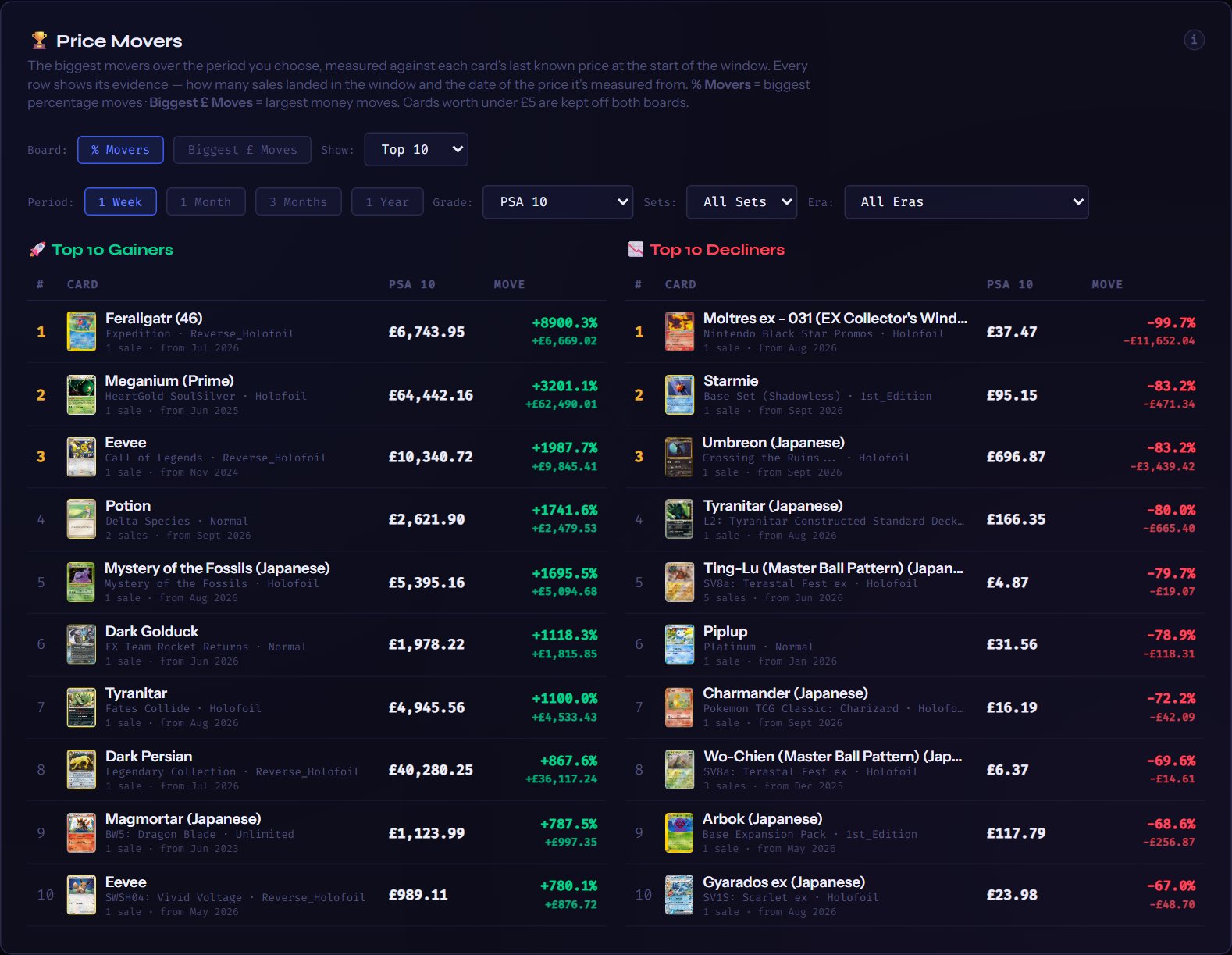
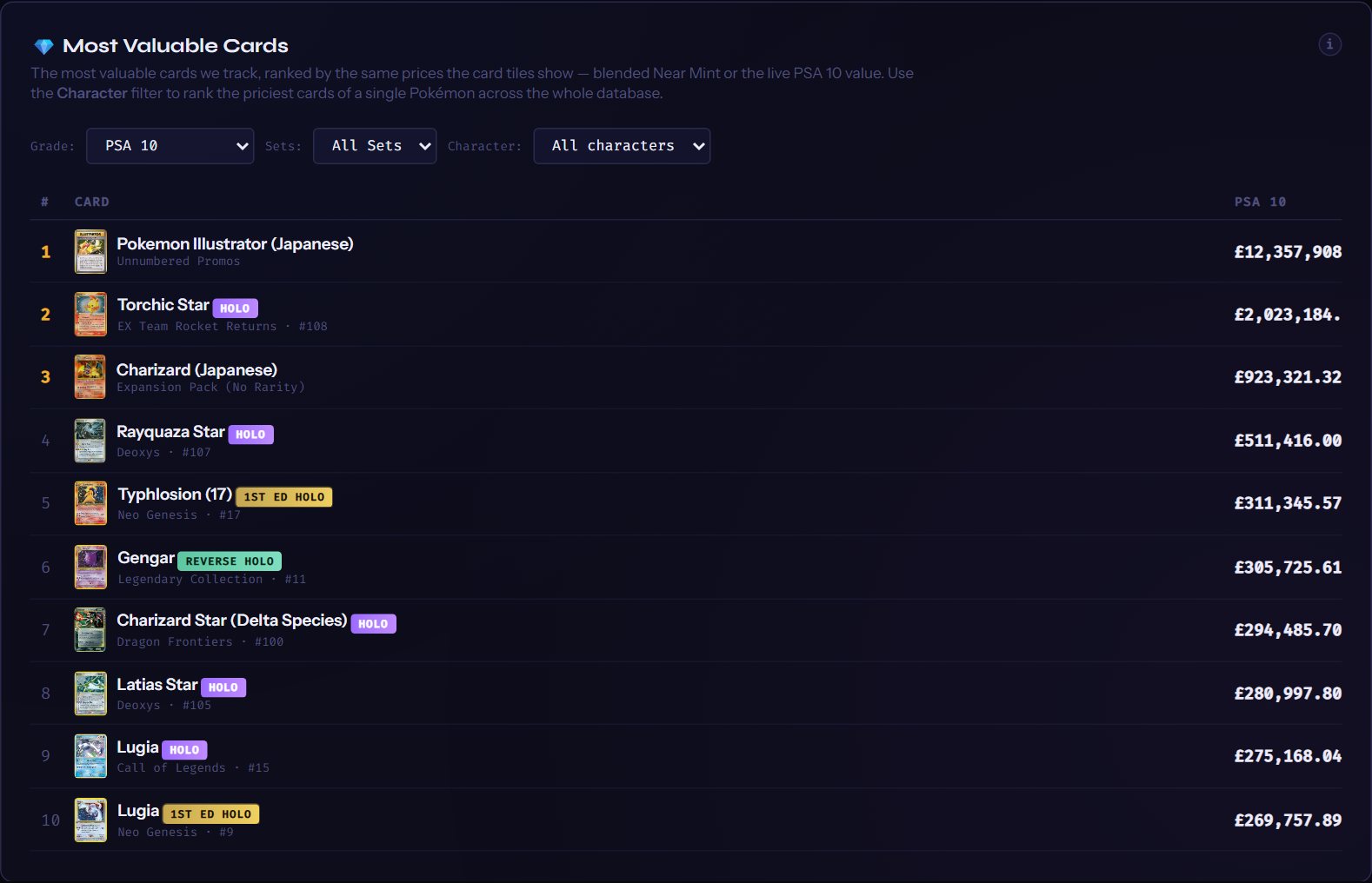
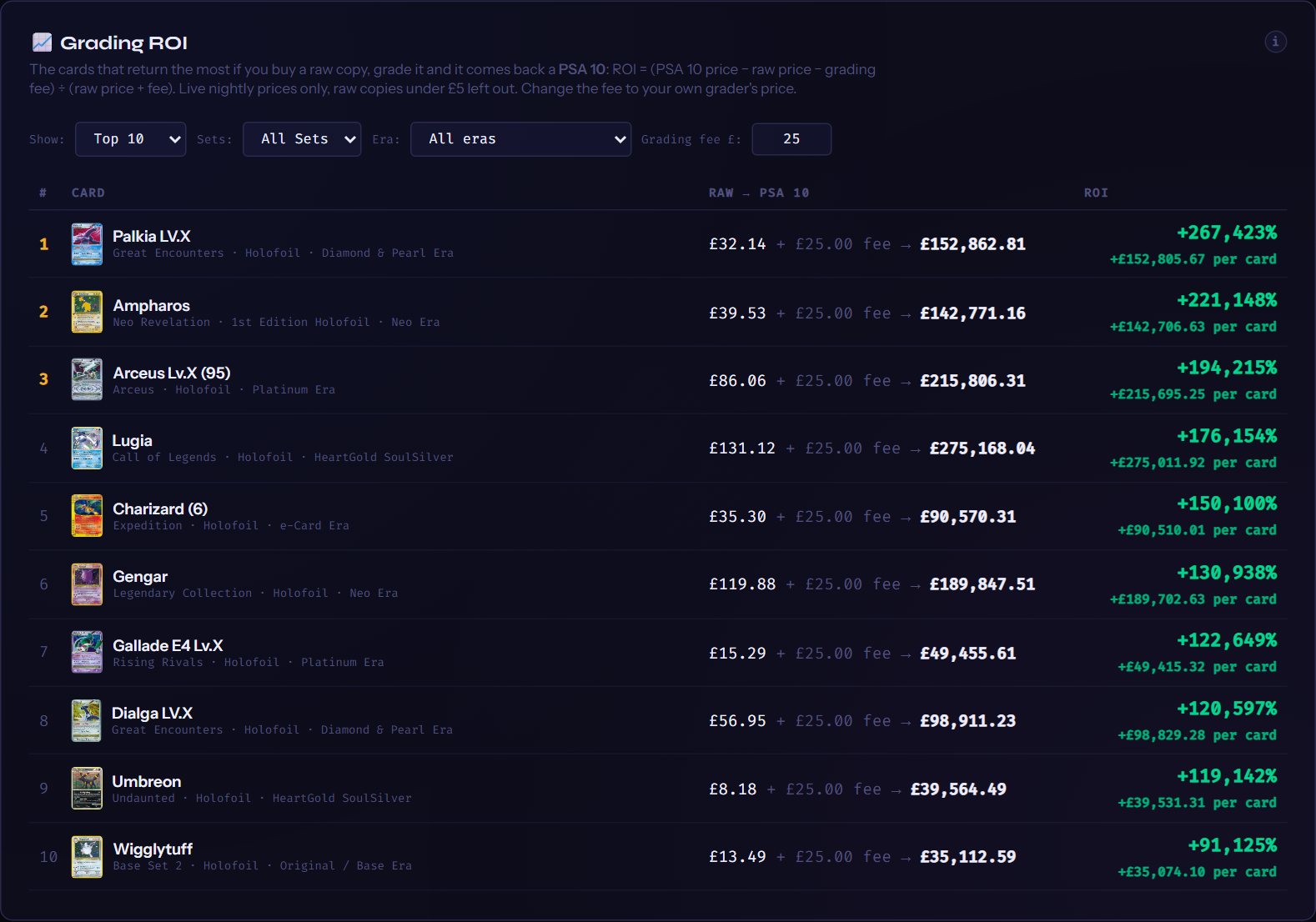
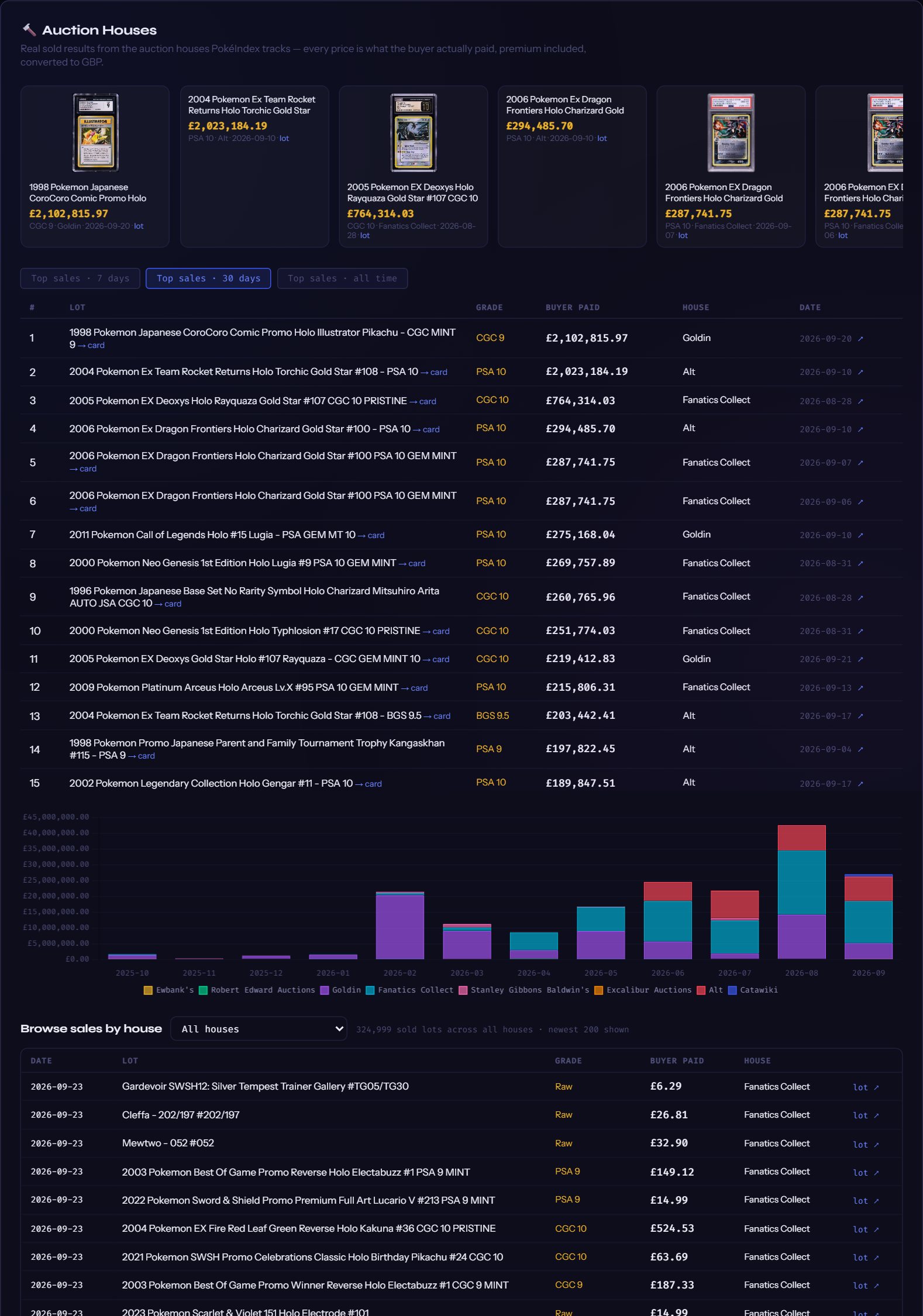
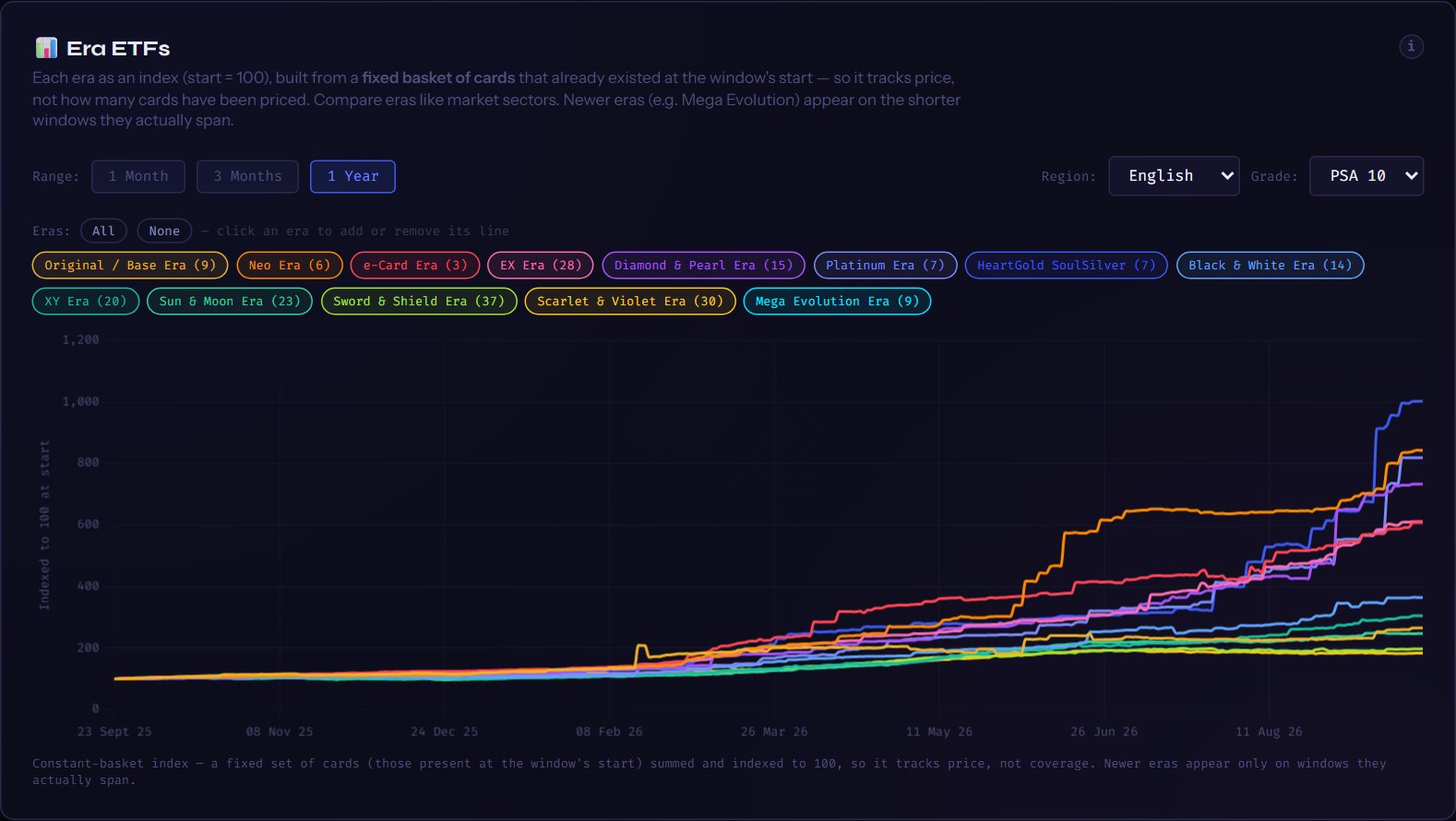
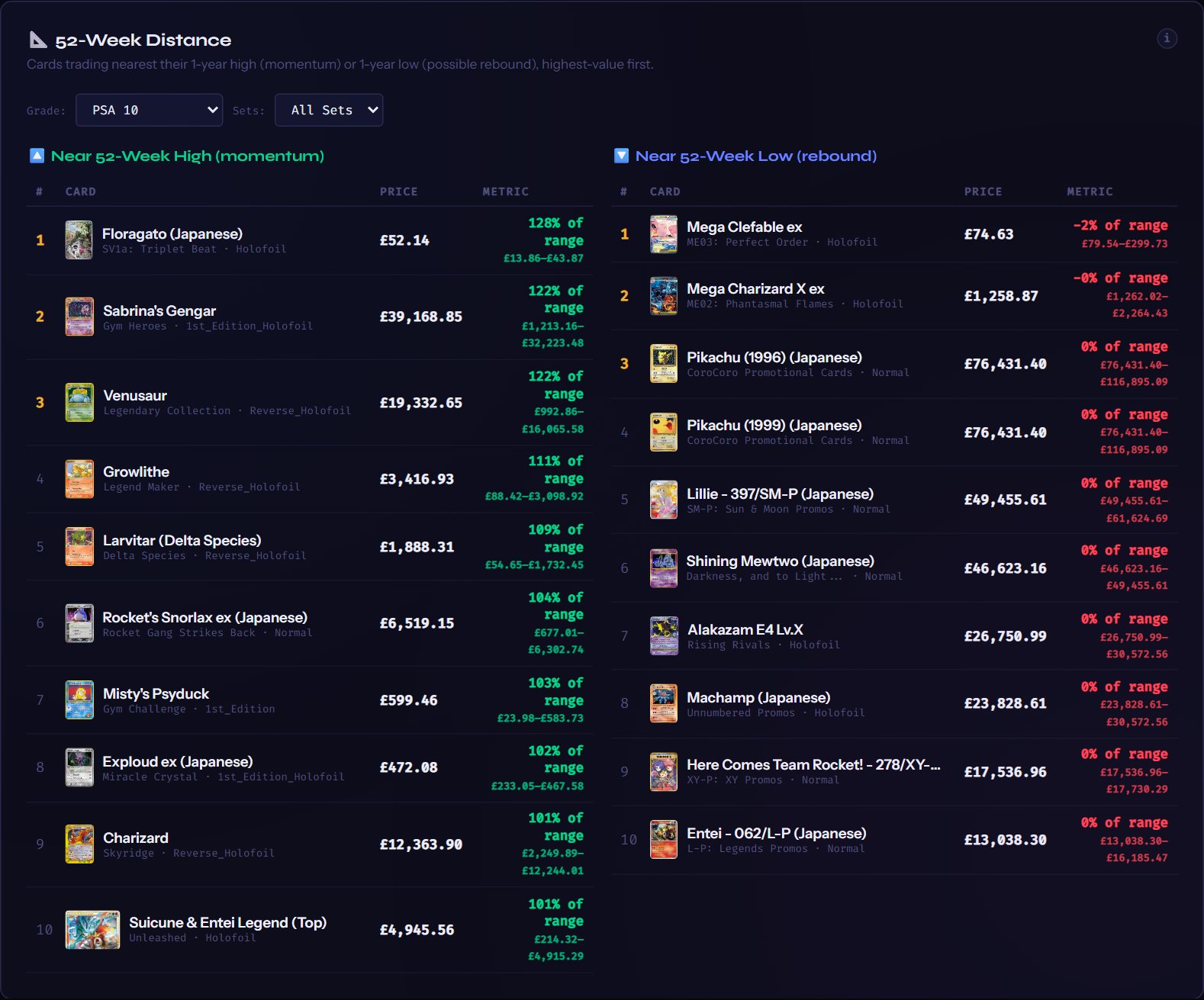
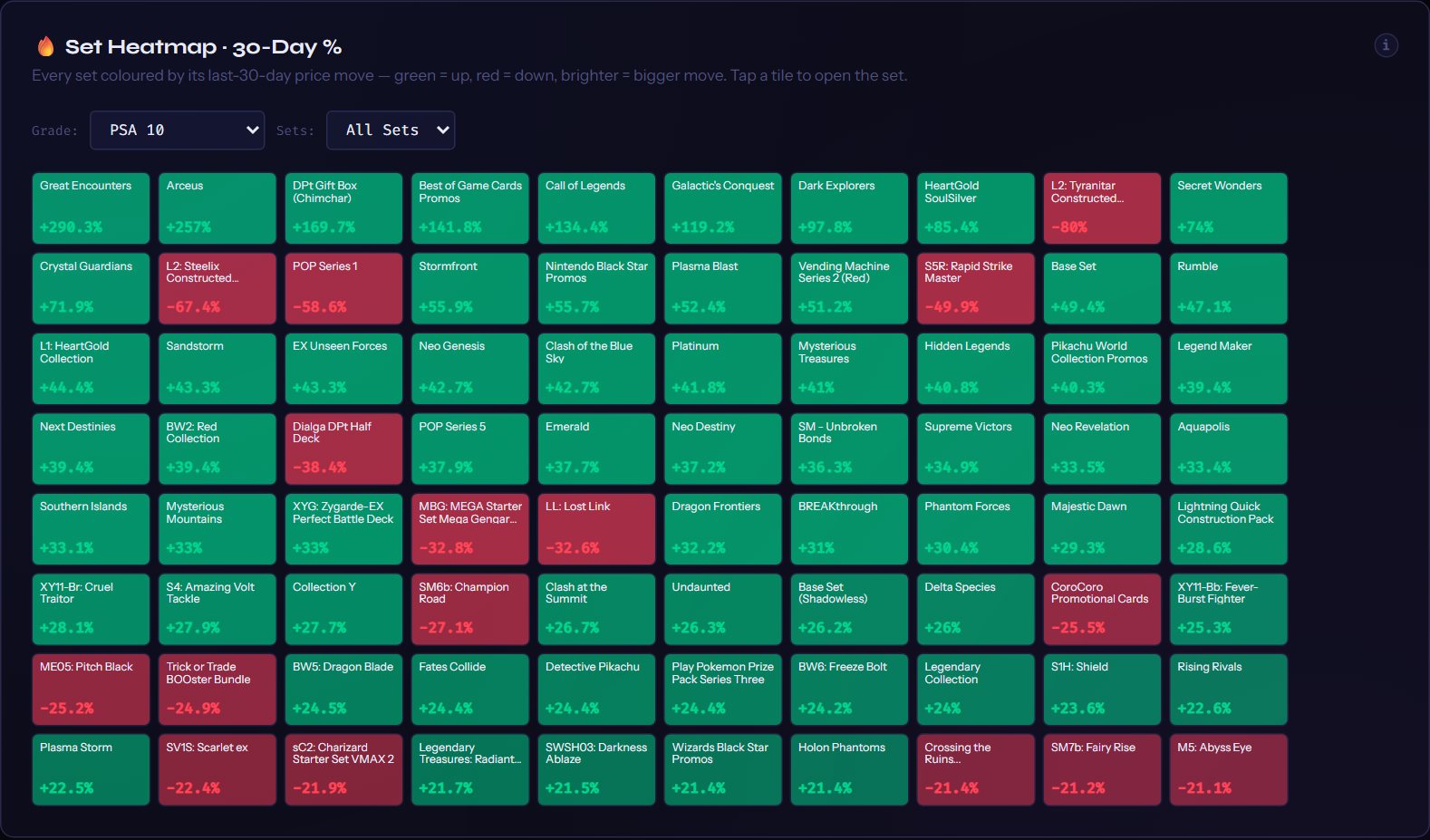
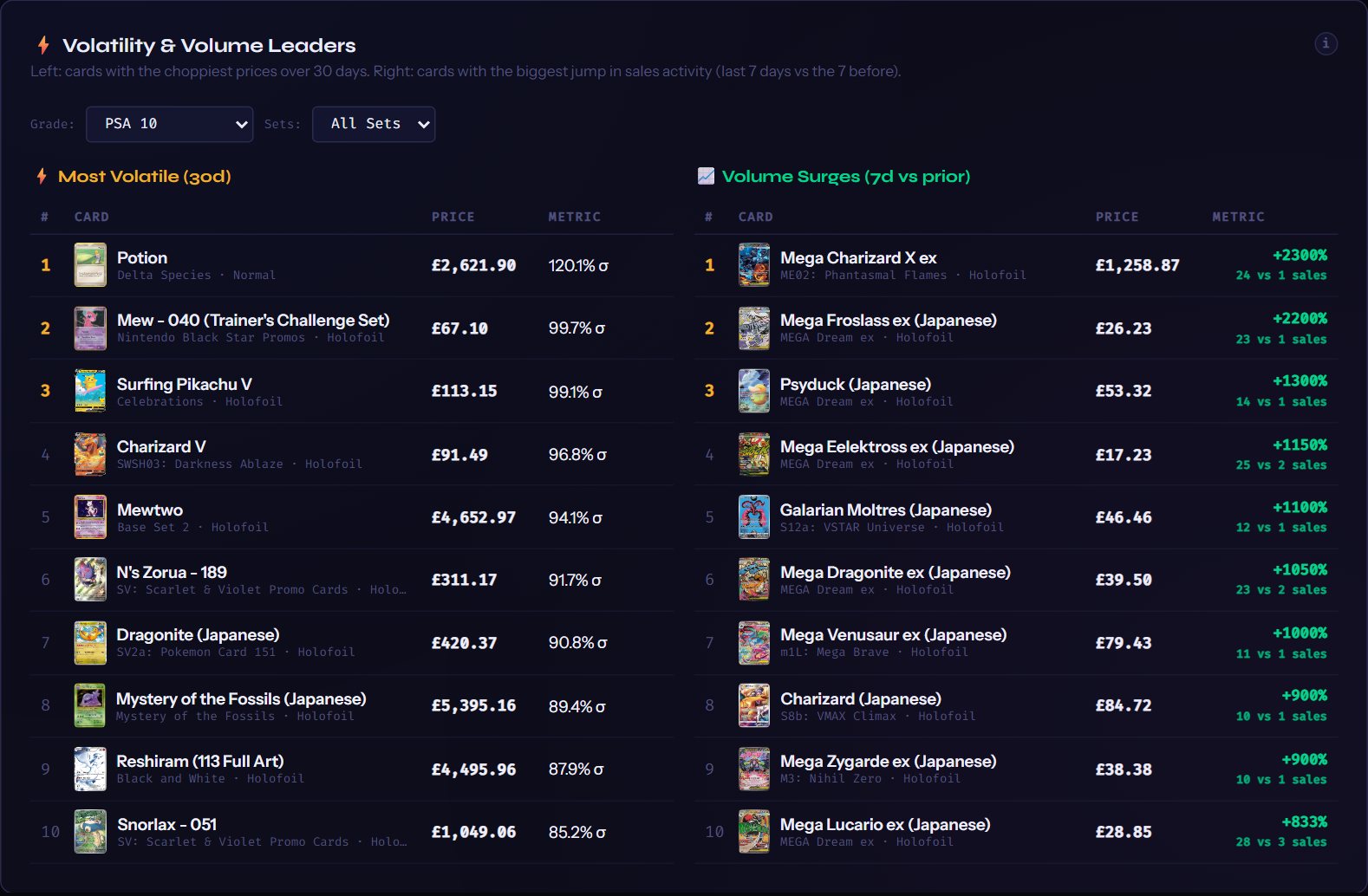
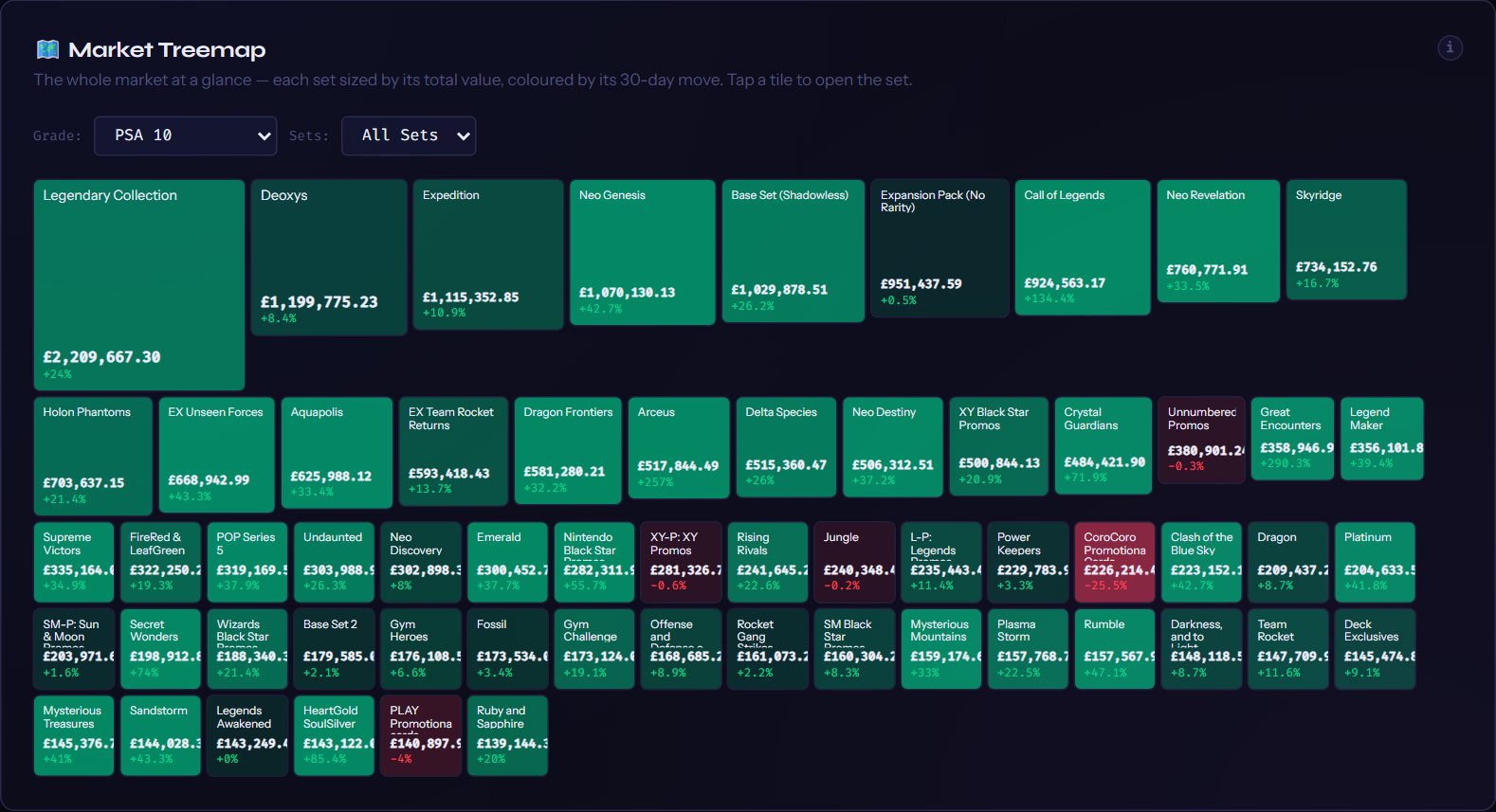
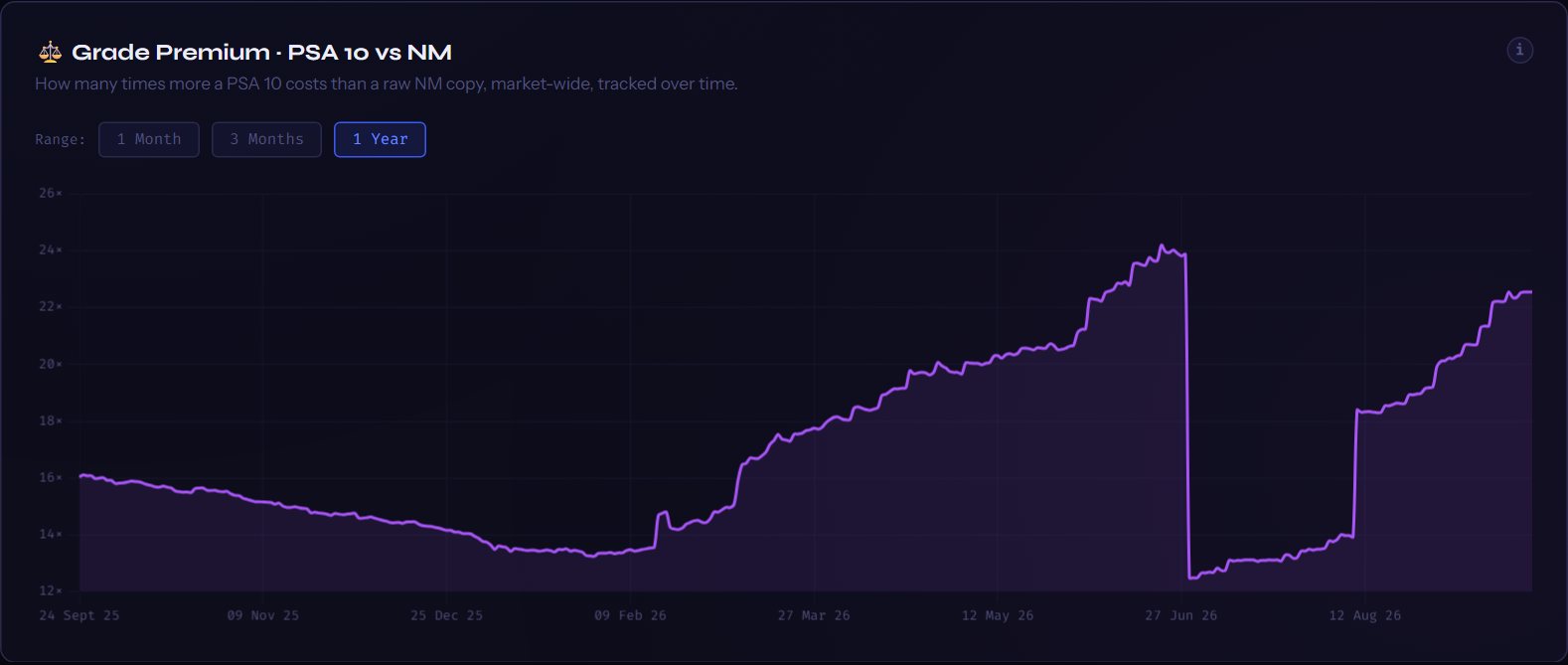
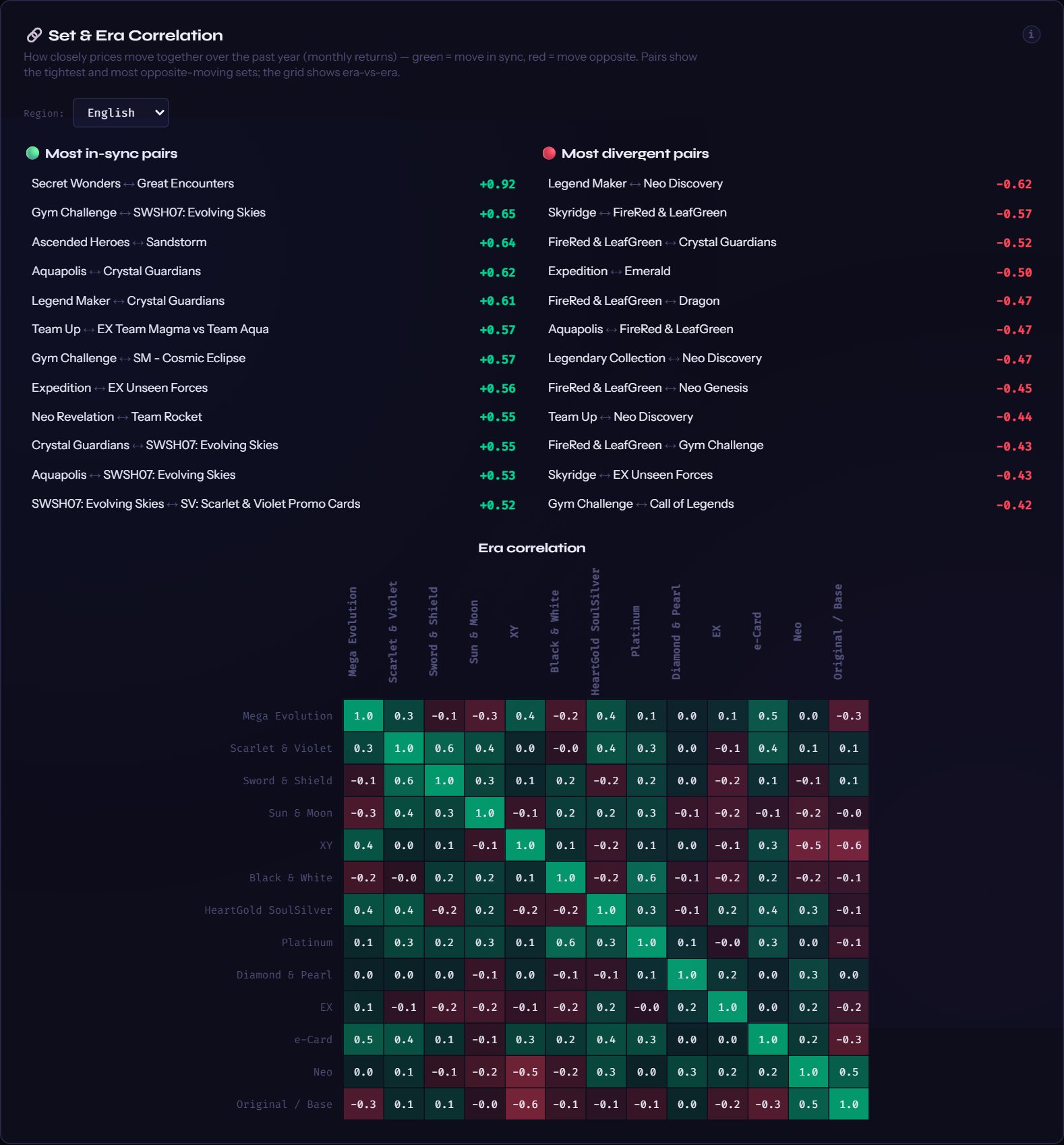
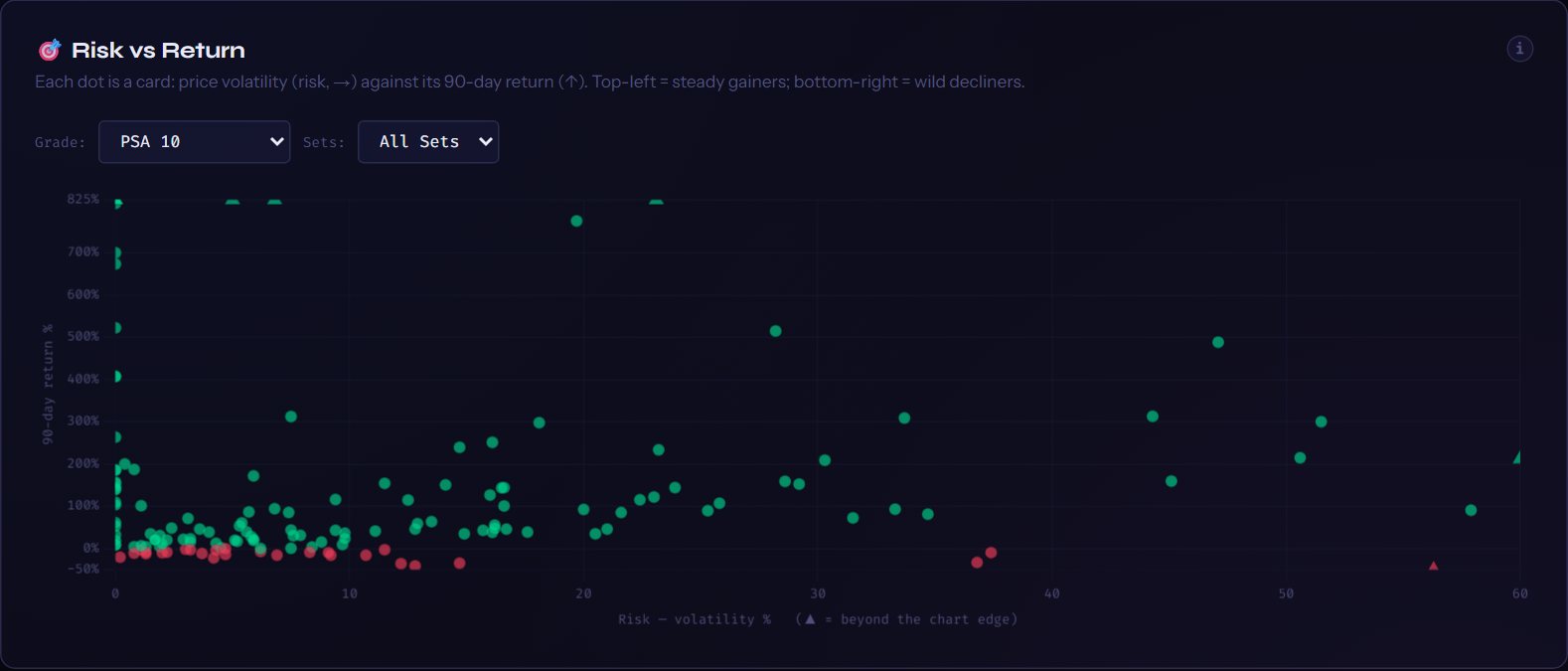
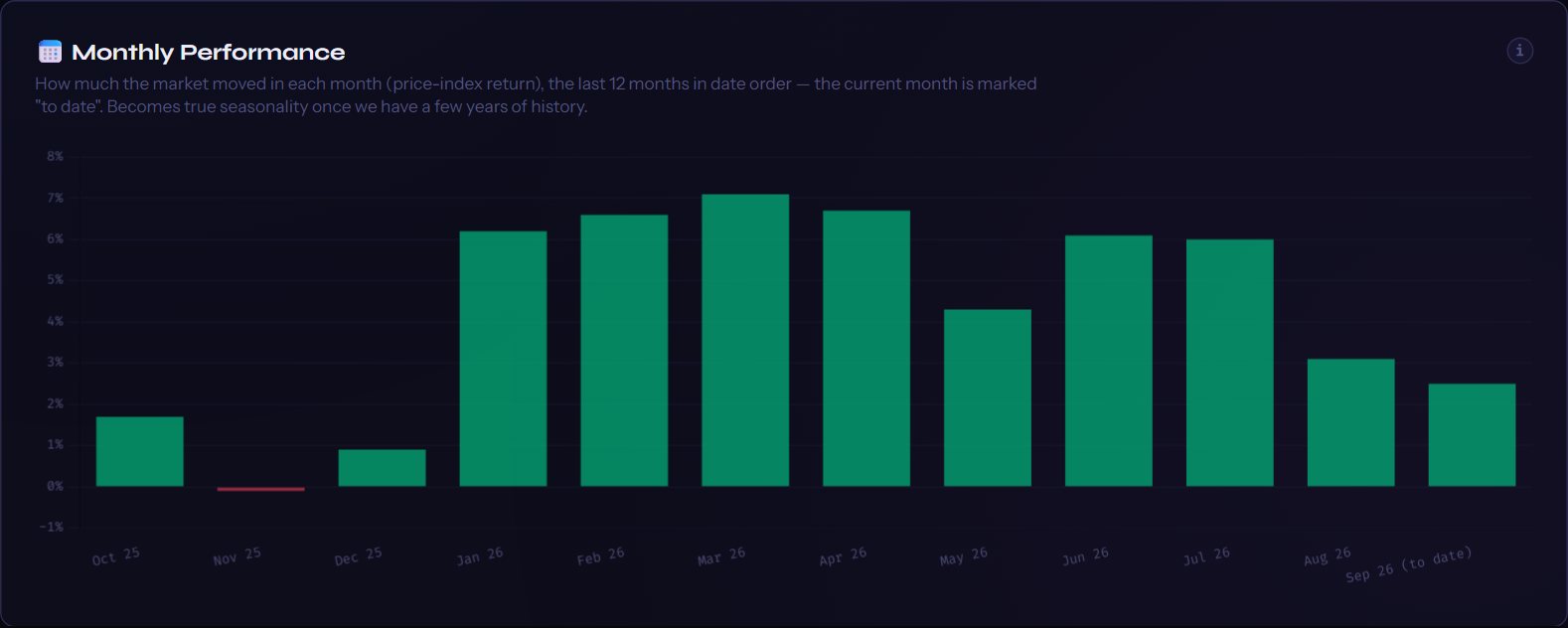
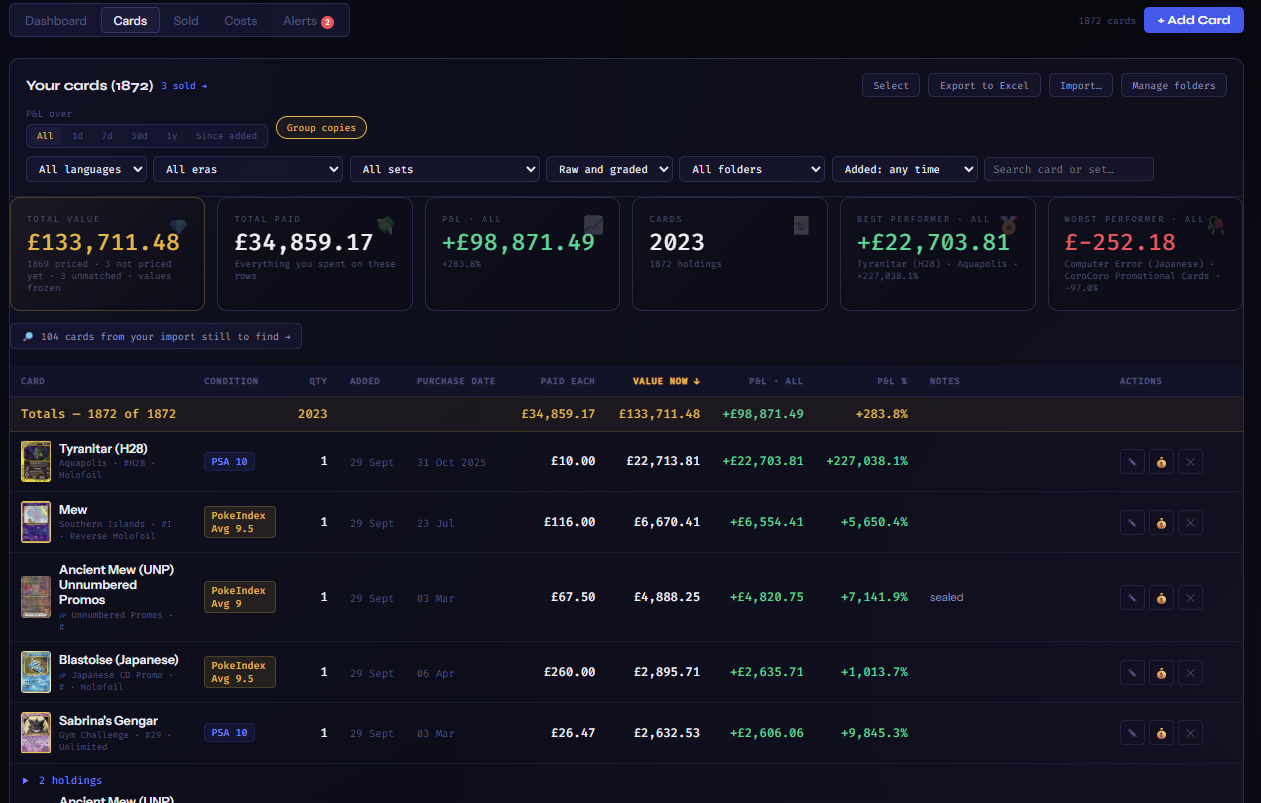
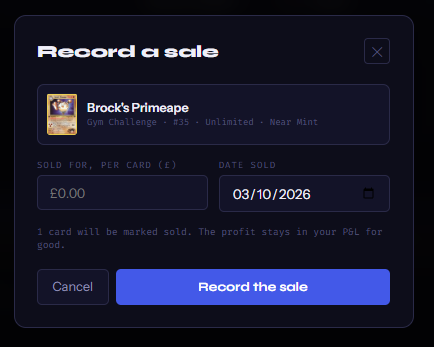
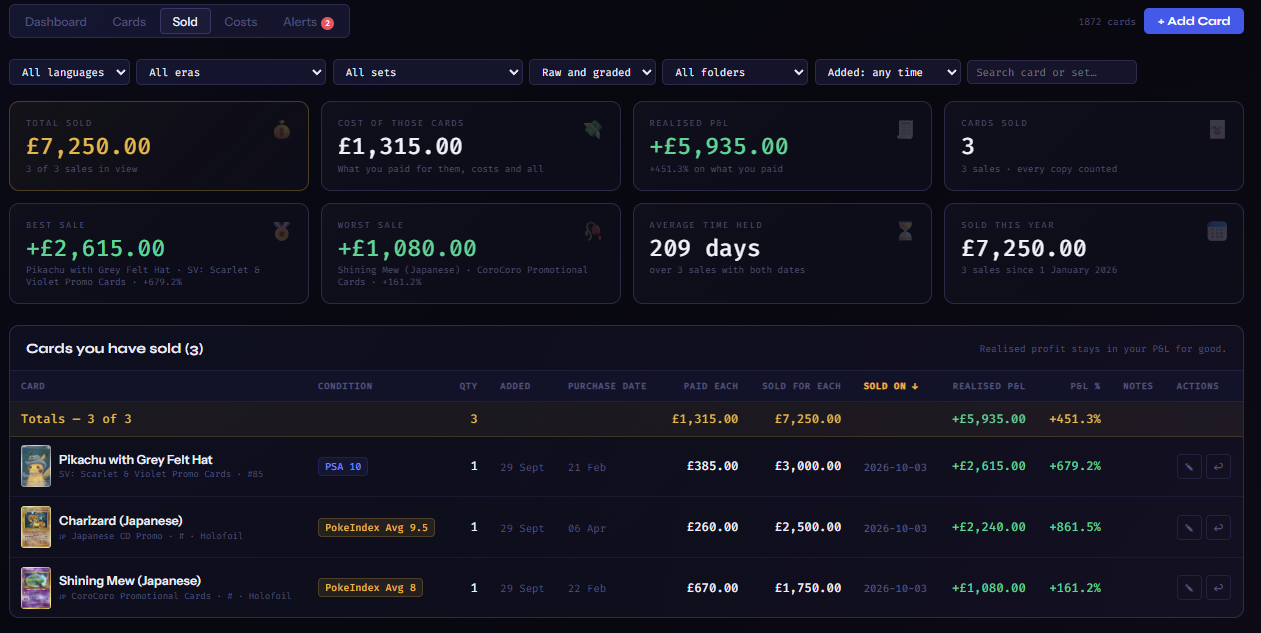
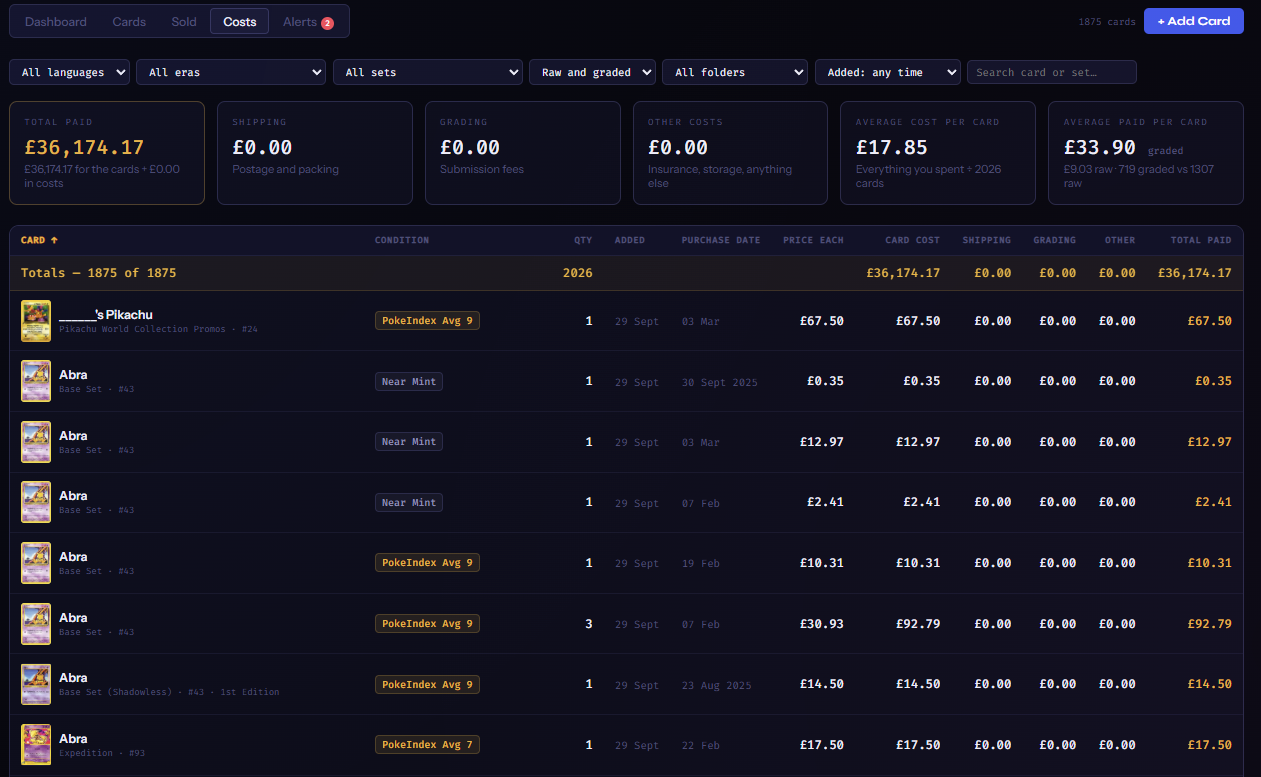
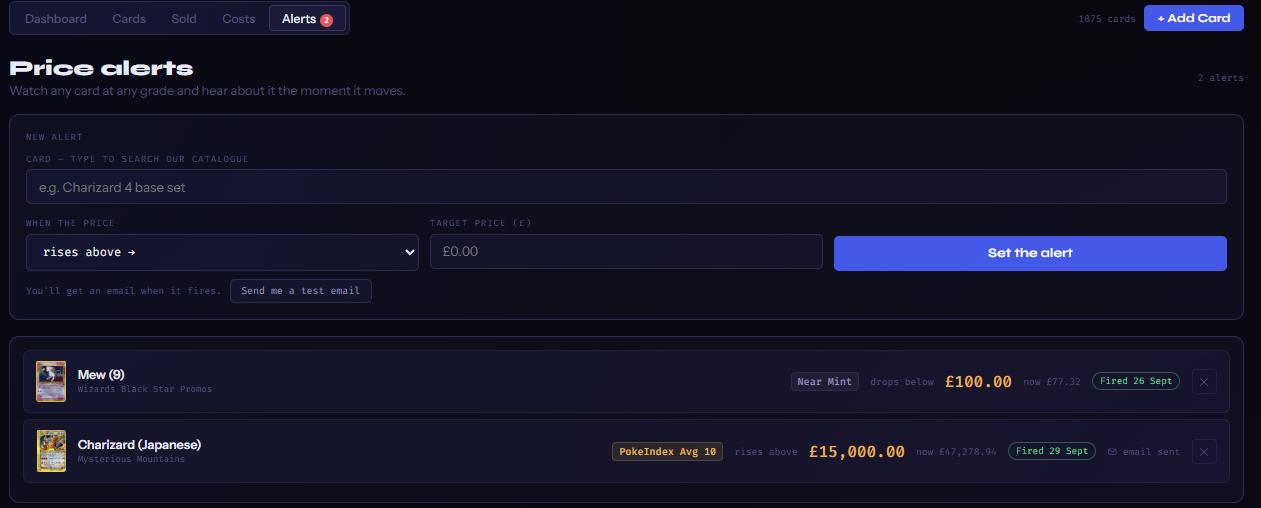
My Portfolio is your own collection, valued every night by the same engine that prices the rest of the site — so your cards move with the market. Add cards one at a time, tick a whole set, or import a file; record what you paid; sell cards when they go; set price alerts. Nothing in it is ever shared or shown to anyone else.
Plans: Collector keeps up to 25 cards and 10 alerts, with the PokéIndex Average and the PSA, BGS and CGC whole grades to price them. Investor is unlimited, adds every grader and half grade, folders, file import and export to Excel. If an Investor drops to Collector later, nothing is deleted: the 25 most valuable cards stay active and the rest are parked — kept, greyed out, unpriced — until you upgrade again.
The page has five tabs — Dashboard Cards Sold Costs Alerts — the card count, and the + Add Card button, which is where we start.
Press + Add Card on the portfolio page, or + Add to Portfolio on any card page (which arrives with the card already picked).
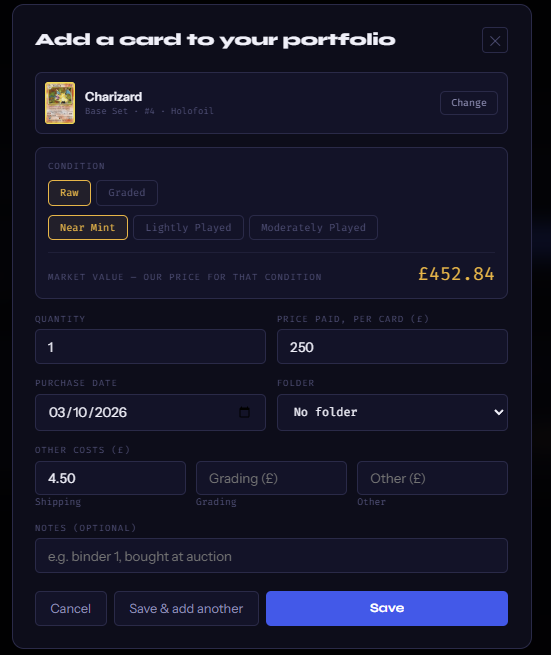
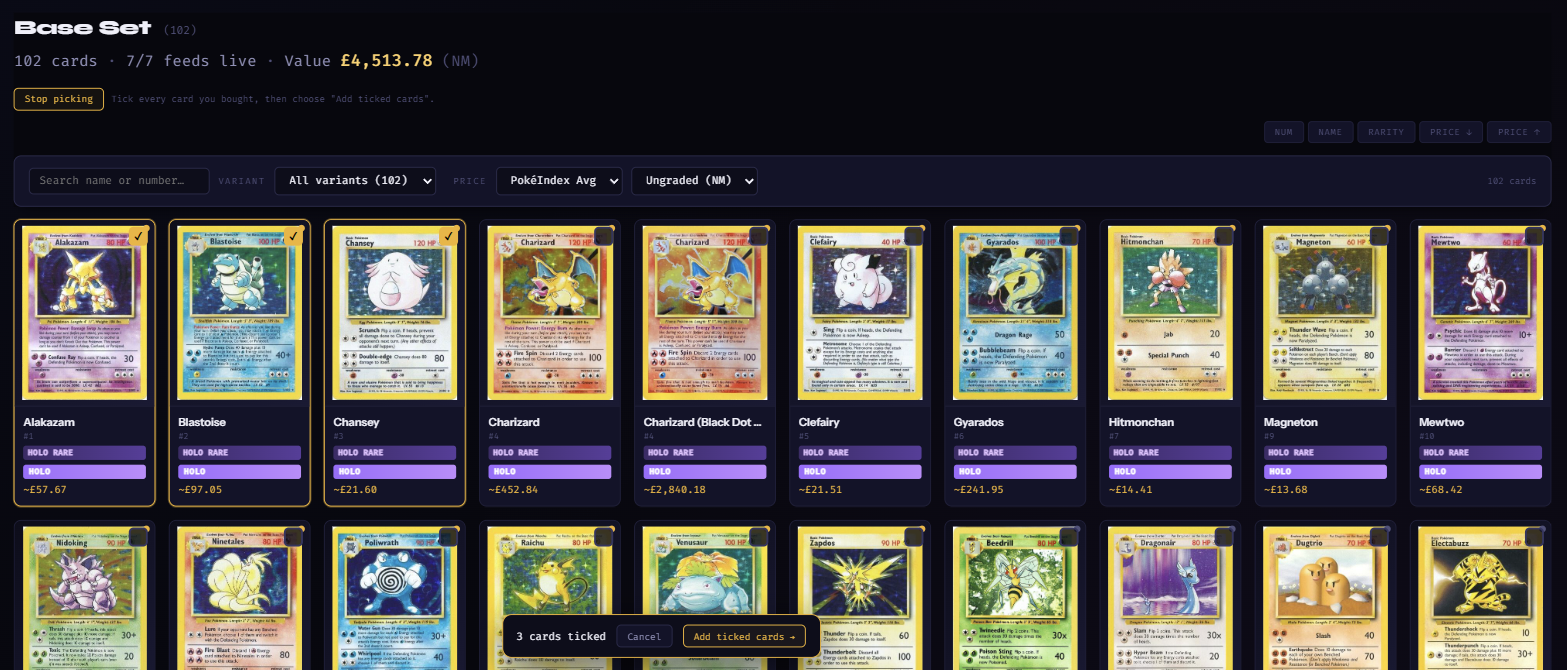
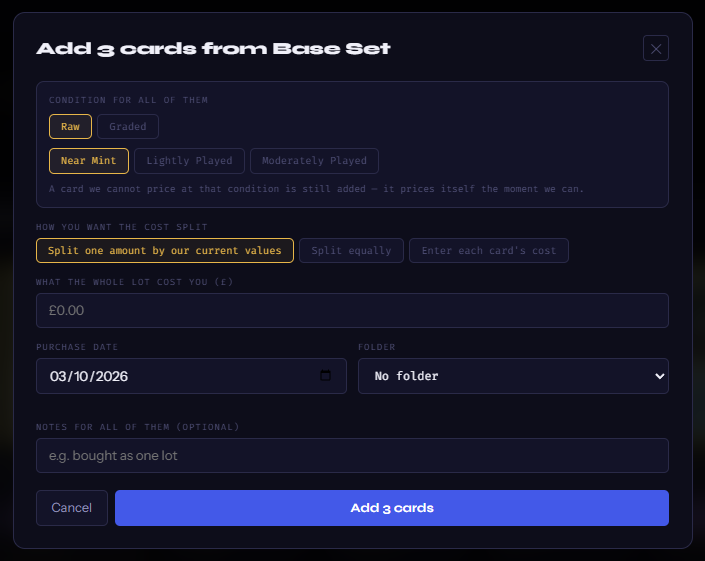
Open any set and press + Add cards from this set. The grid switches to picking mode: tick every card you bought — a tick box appears on each tile — and a bar at the bottom counts them.
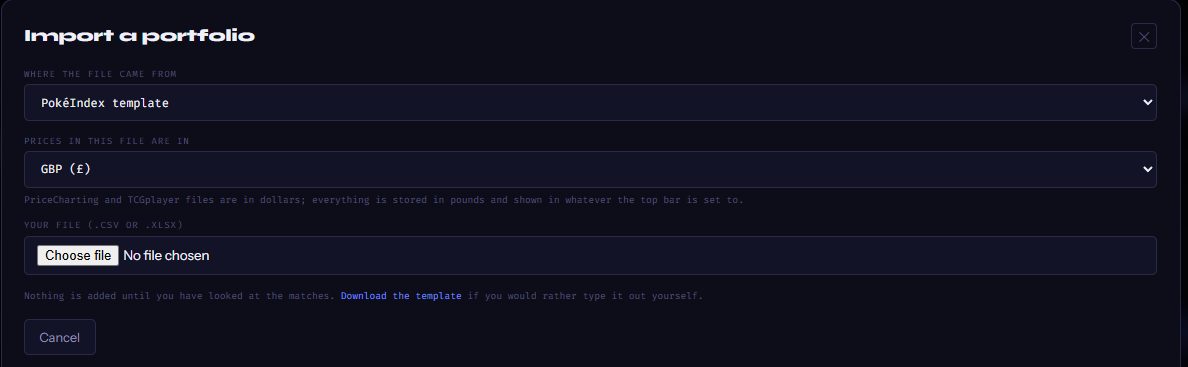
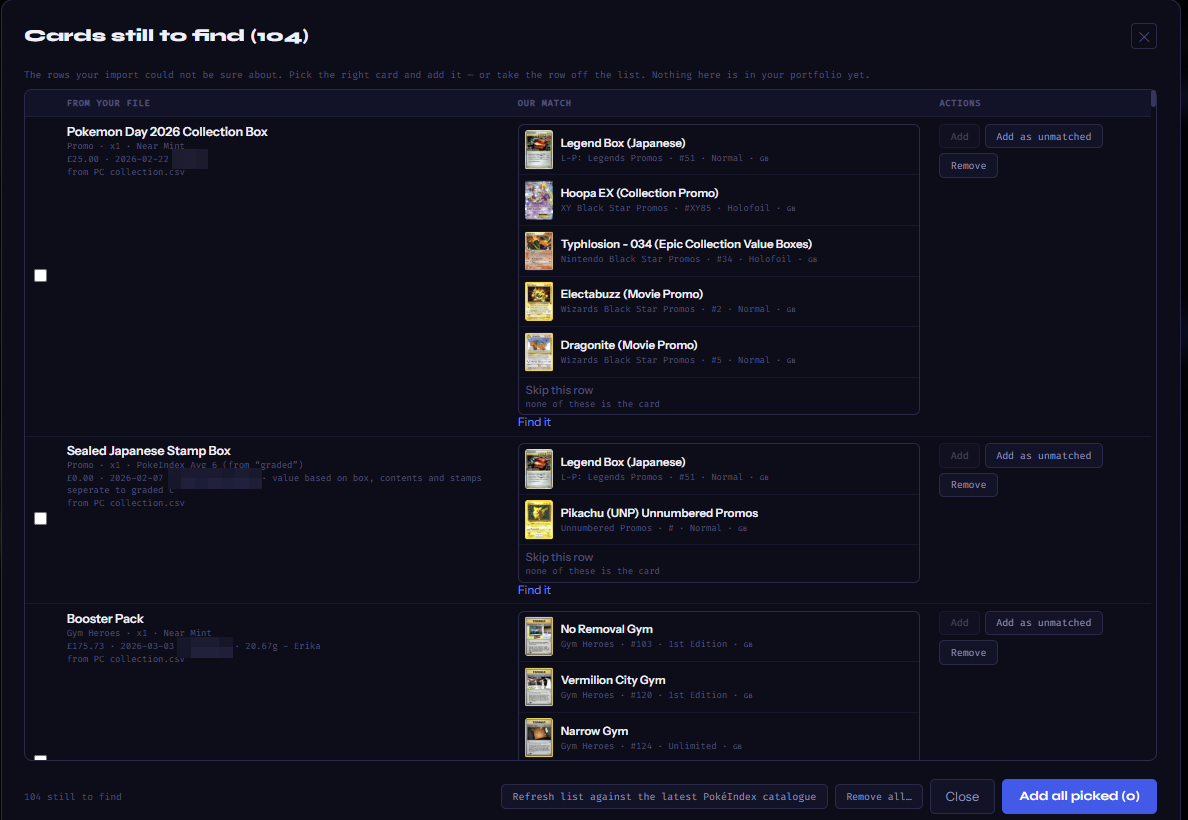
Already keep your collection in a spreadsheet, or on PriceCharting, TCGplayer, Collectr or Pokellector? Press Import… on the Cards tab.
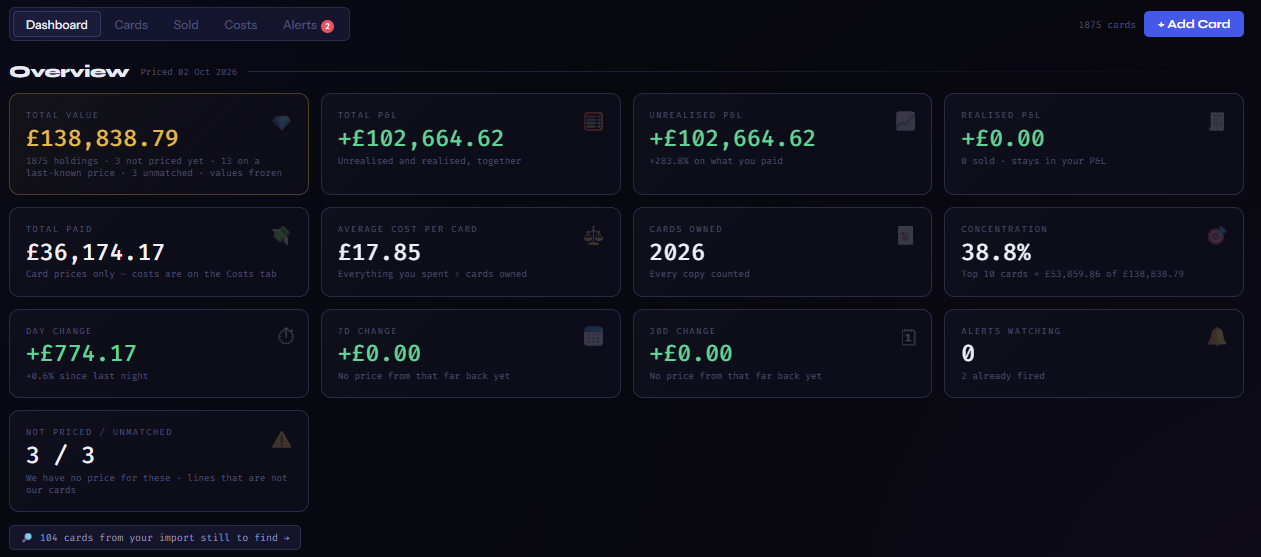
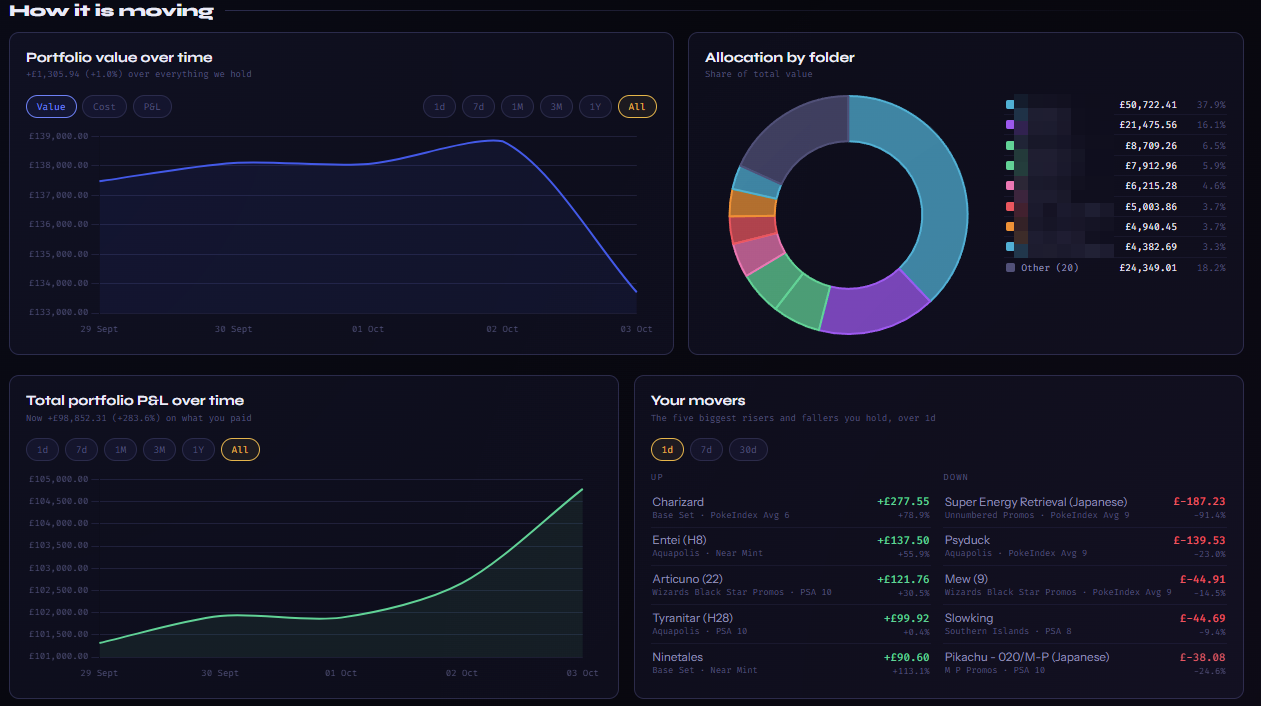
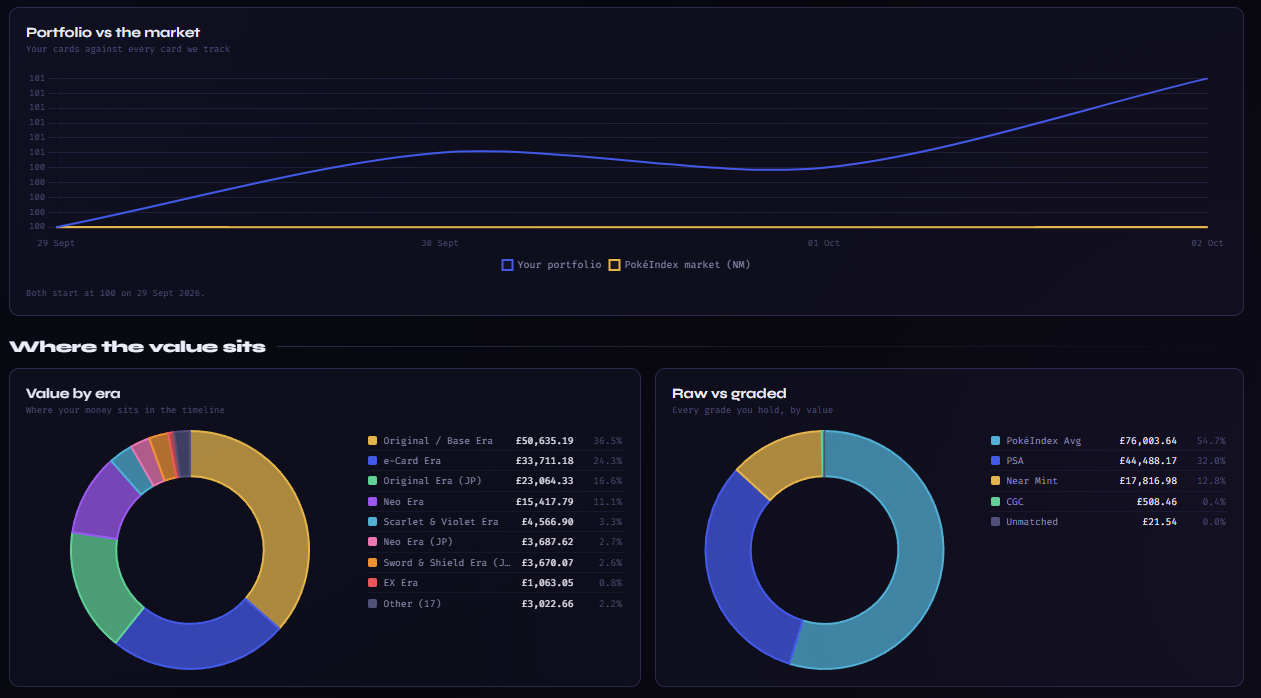
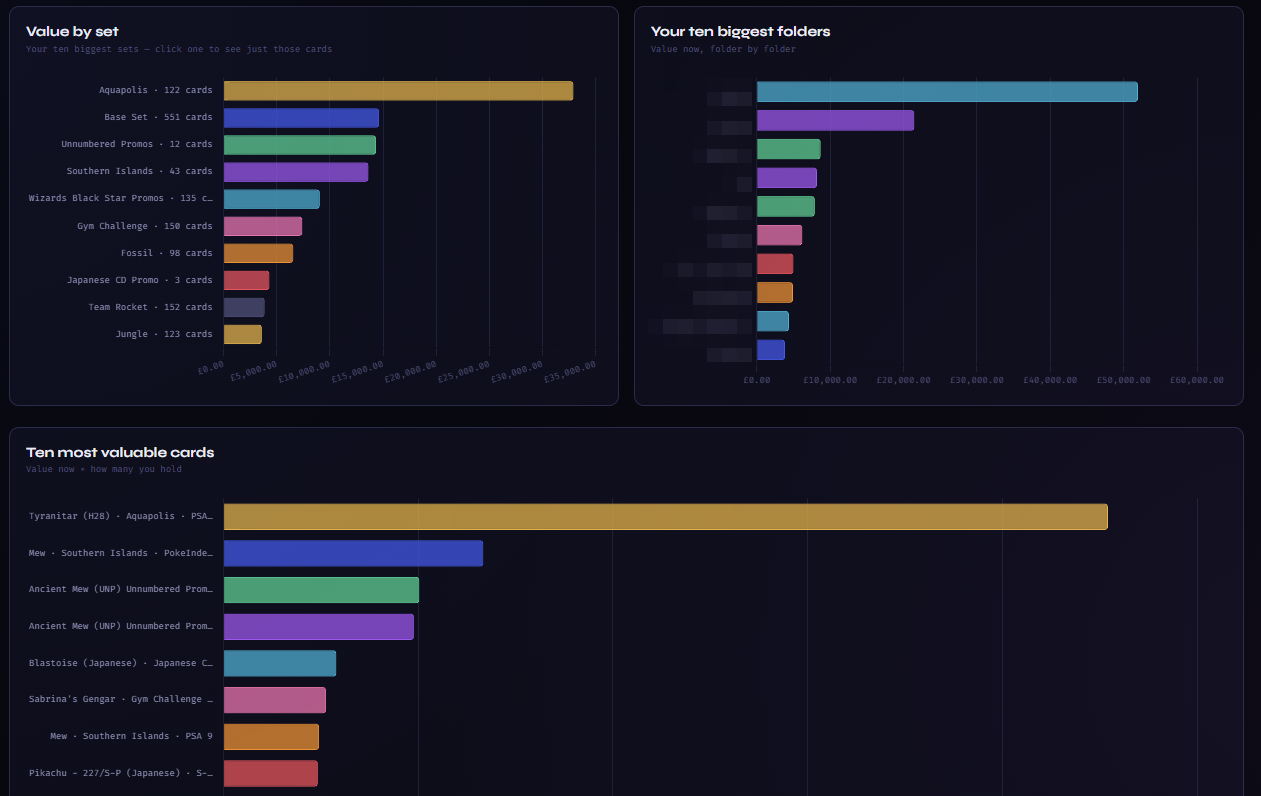
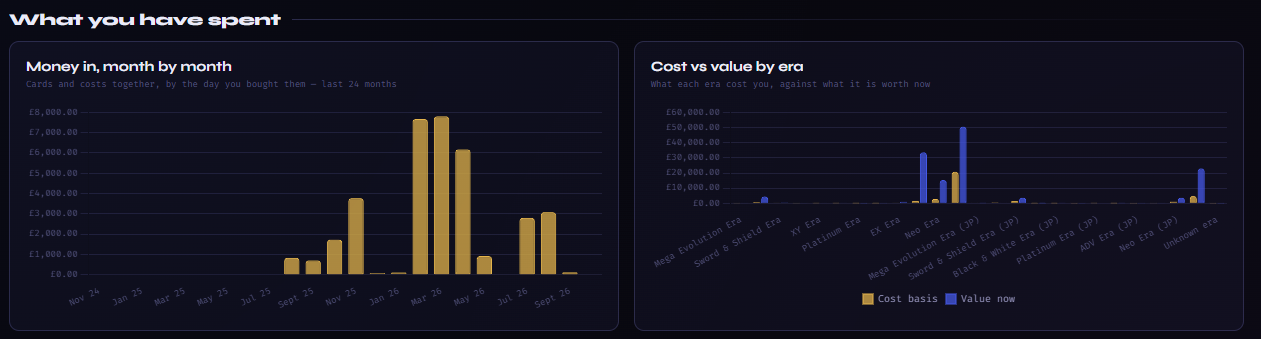
The first tab. Everything on it is worked out from your active cards at last night's prices (the date is next to the title).


PokéIndex (pokeindex.app) is a price guide for Pokémon trading cards. This page explains what we collect, why, and what you can do about it. The short version: we keep the minimum needed to run your account, we never see your card number, and we don't sell or share your details.
PokéIndex is operated from the United Kingdom. Contact us through the form at pokeindex.app/contact.
If you only browse: nothing that identifies you. Our servers see your internet address and the pages you request, which we use for security (rate limits, bot protection) and to keep the site working. Addresses are masked in our logs.
If you create an account: your email address, your name if you give one, and a sign-in method (password, or Google / Apple sign-in). Sign-in is handled by Clerk, a specialist provider; passwords are stored by Clerk, never by us. We keep an account id, your email, your plan, and a count of the free card pages you have opened this month.
If you subscribe: payments are taken by Stripe. Stripe collects your card details directly — we never see or store your card number. We receive from Stripe only what we need to run your plan: whether a payment succeeded, your subscription status and dates, and the last four digits of the card for your receipts page.
If you use the portfolio: the cards, quantities, costs, folders, sold records and price alerts you enter. They are stored on our servers so they follow you between devices. We use them only to show you your own portfolio and to send the alerts you set.
If you contact us: your name, email address and message, so we can reply. Messages are sent to our inbox through Resend (an email provider).
Security records: to stop login sharing we keep a short record of the devices signed into an account (a session id, when it was last seen, and the country it connected from) for up to 7 days, in memory only. To stop automated scraping we count how often an account opens card pages over ten minutes. Neither record is used for anything else.
Where the law requires your consent for advertising cookies, Google's own consent message is shown to you on your first visit, and your choice is recorded and respected there.
We do not use analytics trackers or social-media pixels.
Only the providers we need to run the service, each bound by their own privacy terms and acting on our instructions: Clerk (sign-in), Stripe (payments), Resend (email), Cloudflare (website hosting and security), Railway (our server) and Google (advertising, for visitors who are not paying members). We do not sell, rent or trade personal data.
Our providers operate from the United Kingdom, the European Union and the United States. Where data leaves the UK, it is covered by the providers' standard data-protection terms.
Your account and portfolio for as long as you have an account. Contact messages for up to 12 months. Security records for days, not months. If you delete your account, your account record and portfolio are removed from our server and your Stripe subscription is cancelled; Stripe keeps payment records as the law requires it to.
Under UK data-protection law you can ask to see the data we hold about you, have it corrected, have it deleted, or object to how we use it. You can delete your account yourself from your account menu. For anything else, use the contact form; we answer within a month. If you are unhappy with our answer you can complain to the Information Commissioner's Office (ico.org.uk).
PokéIndex is not directed at children. You must be at least 16 to create an account.
If this policy changes in a way that matters, we will say so on this page and, for account holders, by email.
Please read these terms before using PokéIndex. By using the site or creating an account you agree to them.
PokéIndex is a price guide for Pokémon trading cards. We collect recorded sales from marketplaces and auction houses, combine them with our own estimates, and show prices, charts, a market index and tools such as the portfolio tracker.
Every figure on PokéIndex is either a recorded sale or an estimate derived from recorded sales. Estimates are marked. Prices move, sources make mistakes, and a card you own may sell for more or less than any figure we show. Nothing on PokéIndex is financial, investment or valuation advice, and you should not rely on it as the only basis for buying, selling or insuring cards.
One account per person. You are responsible for keeping your sign-in details private. Accounts are personal and may not be shared: our systems allow two signed-in devices per account and sign out the oldest when a third appears. You must be at least 16 to hold an account.
You may use PokéIndex for your own personal or in-house business purposes. You may not:
The PokéIndex name, the site, its design, text, charts, the market index and our price estimates belong to us. Pokémon, Pokémon character names and card images are trade marks and copyright of their respective owners and are shown only to identify the cards being priced. PokéIndex is an independent price guide and is not affiliated with, endorsed or sponsored by Nintendo, The Pokémon Company, GAME FREAK or Creatures Inc.
What you enter into the portfolio stays yours. You give us permission to store and process it to provide the service. We do not publish it.
We aim for the site to be available all the time, but we do not promise it. Prices and features may change, pause or be withdrawn, and we may suspend or close an account that breaks these terms (with a refund of any unused paid period unless the breach is serious).
We provide PokéIndex with reasonable care but, to the extent the law allows, we are not liable for losses from relying on a price, for business losses, or for losses we could not reasonably have foreseen. For paying members, our total liability for any claim is limited to the fees you paid us in the 12 months before the claim. Nothing in these terms limits liability that cannot be limited by law.
If we change these terms in a way that affects you, we will say so on this page and email account holders at least 14 days before the change takes effect. Continuing to use the site after that date means you accept the new terms.
These terms are governed by the law of England and Wales, and the courts of England and Wales have jurisdiction, without taking away any rights you have as a consumer where you live.
Through the contact form at pokeindex.app/contact.